Major announcements from Kubernetes, AWS, and Google Cloud converge on a single narrative: Kubernetes is becoming the operating system for autonomous agents, massive-scale inference, and AI-native infrastructure.
OpenAI unveils Jalapeño, its first custom AI accelerator. NVIDIA ships DFlash speculative decoding for 15x Blackwell speedups. Plus: vLLM 0.24, Hugging Face one-command inference, and how OpenAI engineers debugged an 18-year-old Linux bug at scale.
This week in AI infrastructure: the first AgentPerf benchmark launched, vLLM v0.23.0 shipped with DeepSeek-V4 and multi-tier KV cache support, and NVIDIA detailed how Dynamo and DOCA are being rebuilt for agentic workloads. Here is what matters.
From session-aware KV cache orchestration to agent-optimized CLIs, the infrastructure layer is racing to support long-running AI agents. NVIDIA Dynamo 1.0 enters production, vLLM and Ollama ship agent-relevant updates, and Hugging Face rebuilds its CLI for machine consumers.
The AI revolution is shifting from training to inference. Explore how vLLM, TensorRT-LLM, and MLOps practices are reshaping computing infrastructure for the inference era.
The AI infrastructure landscape of 2026: vLLM dominates inference, AMD and TPUs challenge NVIDIA, vector databases mature for RAG, and AI observability becomes essential for production ML systems.
The CNCF's new Kubernetes AI conformance program aims to solve portability and predictability challenges for AI workloads running on the 80% of enterprises already using Kubernetes.
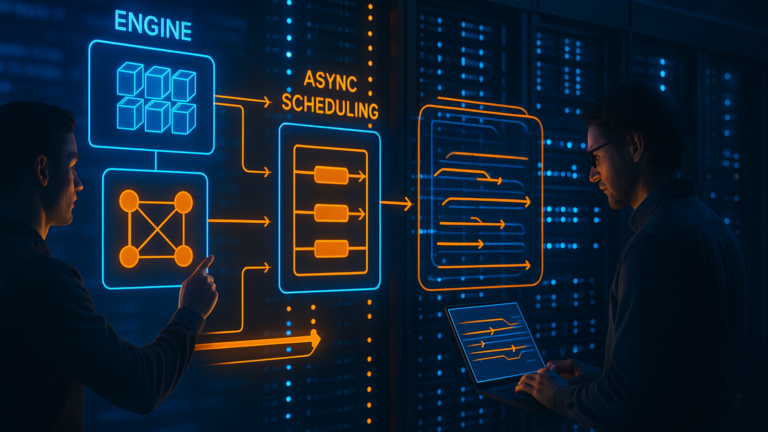
vLLM v0.19.0 brings full Google Gemma 4 architecture support, speculative decoding with zero-bubble async scheduling, and significant Model Runner V2 maturation for improved throughput and efficiency.
The latest vLLM release adds Google Gemma 4 architecture support with MoE, multimodal, and tool-use capabilities, plus breakthrough performance improvements through zero-bubble async scheduling.
Six key takeaways from Amsterdam show cloud-native has moved decisively from experimentation to execution - with AI workloads, data sovereignty, and platform engineering dominating the conversation.
vLLM v0.18.0 introduces production-ready gRPC serving and GPU-less preprocessing for multimodal workloads.
Cloudflare enters the large model inference game with Kimi K2.5 on Workers AI, offering frontier-level reasoning at a fraction of proprietary model costs.
Kubernetes 1.34 brings Dynamic Resource Allocation to GA, enabling proper GPU sharing, topology-aware scheduling, and gang scheduling for AI/ML workloads.
The Kubernetes community announces a new working group focused on developing standards and best practices for AI Gateway infrastructure, including payload processing, egress gateways, and Gateway API extensions for machine learning workloads.
Ollama 0.18 brings official OpenClaw provider support, up to 2x faster Kimi-K2.5 performance, and the new Nemotron-3-Super model designed for high-performance agentic reasoning tasks.
vLLM 0.17 brings PyTorch 2.10, FlashAttention 4 support, and the new Nemotron 3 Super model, delivering next-generation attention performance for LLM inference.
vLLM 0.17.1 adds Nemotron 3 Super and, more importantly, patches several MoE and TRT-LLM edge cases. That is the real story: production LLM serving is still a game of backend-specific correctness, especially once MoE, FP8, and mixed execution paths enter the room.
Ollama’s 0.17.8 release candidate is not a flashy model-drop release. It is a runtime-hardening release: better GLM tool-call parsing, more graceful stream disconnect handling, MLX changes, ROCm 7.2 updates, and small fixes that make local inference feel more operational and less hobbyist.
Ollama 0.17.7 adds better handling for thinking levels (e.g., ‘medium’) and exposes more context-length metadata for compaction. It’s a small release that hints at a larger shift: local model runtimes are growing the same control surfaces as hosted LLM platforms.
CNCF argues the AI stack is converging on Kubernetes—data pipelines, training, inference, and long-running agents. Here’s what’s actually driving the migration, the hidden operational tax it removes, and the platform-level standards teams should lock in before the next wave hits.