
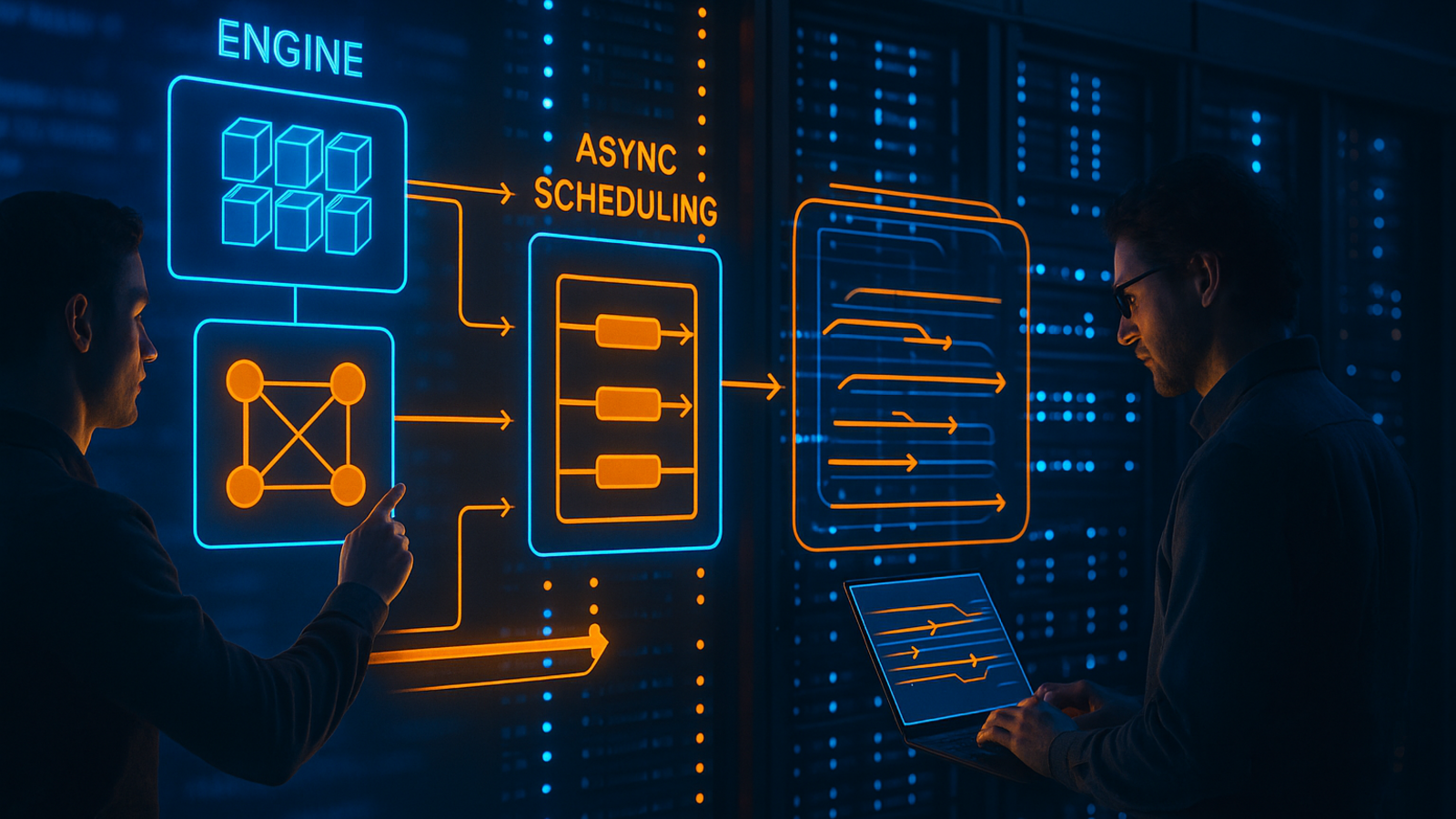
The vLLM project has released version 0.19.0, a major milestone that brings comprehensive support for Google’s Gemma 4 architecture alongside breakthrough performance optimizations. With 448 commits from 197 contributors (including 54 new contributors), this release represents one of the most substantial updates in the project’s history and establishes vLLM as a leading inference engine for production AI deployments.
Gemma 4: Full Architecture Support
vLLM v0.19.0 introduces complete support for Google Gemma 4, encompassing all major architectural variants including Mixture of Experts (MoE), multimodal capabilities, reasoning modes, and tool-use functionality. This implementation requires transformers 5.5.0 or newer and leverages significant backend improvements to handle Gemma 4’s complex inference patterns efficiently on modern GPU hardware.

Gemma 4 represents a significant evolution in open-weight models, featuring multiple sizes and specialized variants for different use cases. The MoE variants particularly benefit from vLLM’s optimized routing and batching mechanisms, which minimize memory overhead while maximizing throughput for sparse activation patterns. Multimodal support enables vision-language applications, allowing the same inference infrastructure to handle both text and image inputs.
For production deployments, the vLLM team recommends using the pre-built Docker image vllm/vllm-openai:gemma4 which includes all necessary dependencies configured for optimal performance out of the box. This image bundles the correct transformers version, optimized CUDA kernels, and pre-configured environment variables tested across A100, H100, and consumer GPU variants.
Zero-Bubble Async Scheduling with Speculative Decoding
One of the most significant performance enhancements in this release is the integration of zero-bubble async scheduling with speculative decoding. Previously, these two optimization techniques operated independently—now they work together to eliminate pipeline bubbles and maximize GPU utilization in ways previously impossible with synchronous execution models.
Traditional inference pipelines suffer from bubbles—idle periods where the GPU waits for CPU scheduling decisions, KV cache management, or token sampling operations. The zero-bubble approach ensures that the forward pass, sampling, and scheduling operations overlap completely, leaving no idle GPU cycles. This is achieved through careful pipelining of operations and pre-computation of scheduling decisions before the current batch completes.
When combined with speculative decoding—which uses smaller draft models to predict token sequences and verify them in parallel—throughput improvements can reach 30-50% for compatible workloads. The key insight is that speculation and verification can run concurrently with other batch processing, filling what would otherwise be scheduling bubbles with useful speculative work.
Model Runner V2 Maturation
Model Runner V2 (MRV2) continues its evolution with several critical additions that improve both performance and correctness:
- Piecewise CUDA graphs for pipeline parallelism, enabling more efficient execution across multiple GPUs by breaking computation into smaller sub-graphs that can be scheduled independently
- Speculative decoding rejection sampler with support for greedy sampling and log probability calculations, ensuring that speculative verification maintains the same statistical properties as direct generation
- Multi-modal embeddings for speculative decoding, expanding support to vision-language models and enabling speculation on image-to-text generation tasks
These improvements make MRV2 increasingly suitable for production deployments requiring low latency and high throughput. The piecewise CUDA graphs particularly benefit tensor-parallel deployments where communication overhead between GPUs previously limited scalability.
Production Considerations
When upgrading to v0.19.0, consider the following operational factors:
- Test speculative decoding with your specific model mix—performance gains vary based on model architecture and sequence patterns. Models with consistent output patterns benefit most from speculation
- Monitor GPU memory utilization with the new async scheduling; the overlap may reveal memory bottlenecks previously hidden by idle time. Adjust
gpu_memory_utilizationif needed - Update container images to pick up security patches included in the base dependencies. The v0.19.0 images include updated CUDA and PyTorch versions
- Validate tensor-parallel configurations with piecewise graphs, especially for models requiring model parallelism across multiple GPUs
The combination of Gemma 4 support and performance optimizations positions vLLM v0.19.0 as a compelling upgrade for organizations running large-scale inference workloads on Kubernetes. The improvements to async scheduling and speculative decoding particularly benefit high-throughput serving scenarios where request batching and latency requirements create challenging optimization constraints.

