
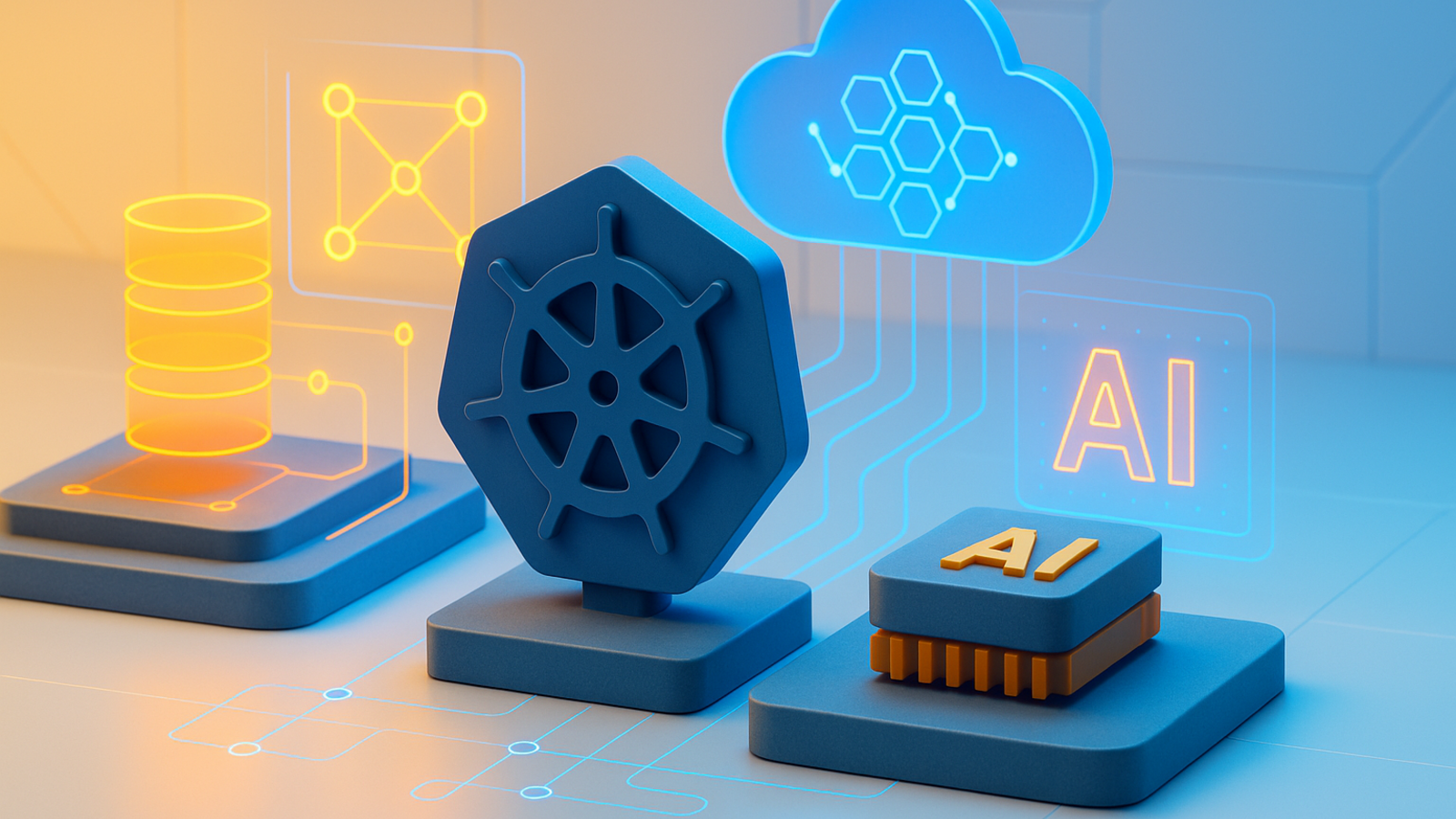
The cloud native ecosystem is experiencing a convergence that few predicted even two years ago: Kubernetes is becoming the universal substrate for AI workloads, while observability standards are simultaneously hardening into the bedrock of modern operations. The stories dominating July 2026 are not about incremental container improvements or yet another service mesh debate. They are about whether Kubernetes can credibly serve as the control plane for inference at scale, and whether OpenTelemetry has finally earned its place as the single standard for telemetry collection.
OpenTelemetry Graduates: The Observability Standard Is Now Official
On May 11, 2026, the Cloud Native Computing Foundation (CNCF) announced that OpenTelemetry had graduated to the foundation’s highest maturity level. For an organization that also hosts Kubernetes, Prometheus, and Envoy, that distinction matters. Graduation means the project has demonstrated sustainable governance, broad production adoption, and a healthy contributor community. OpenTelemetry now counts over 1,200 active contributors and is supported by virtually every major observability vendor.
The practical impact is straightforward: instrumentation portability is no longer aspirational. New Relic, Datadog, Grafana, and Cloudflare have all built or are building deep OpenTelemetry integrations. New Relic’s hybrid agent approach lets teams incrementally adopt OpenTelemetry APIs while continuing to route telemetry through existing agents, removing the "big-bang migration" risk that previously stalled adoption. Grafana Labs, meanwhile, is betting heavily on Anthropic models being available in-region across every major cloud — a multi-cloud observability strategy that only works if telemetry collection is vendor-neutral from the start.
But graduation is not the end of the story. OpenTelemetry is now pushing into the next phase of scale. OTel-Arrow Phase 2 is exploring what happens when Apache Arrow’s columnar format is used not just for transport, but as the primary in-pipeline data representation. Early results from the OTel-Arrow Dataflow Engine show that keeping telemetry in Arrow batches end-to-end dramatically reduces CPU and memory overhead during transformation. At the scale modern platforms operate — where a single Kubernetes cluster can emit millions of spans per minute — that efficiency gain translates directly into operational cost savings.
Kubernetes as the AI Control Plane
While observability was cementing its standards, the Kubernetes community spent the first half of 2026 answering a different question: can Kubernetes credibly orchestrate AI inference? The answer, increasingly, is yes — but only if the control plane learns new primitives.
Modern LLM inference is not a single container. A production deployment of a 70B parameter model typically runs prefill workers (compute-bound, processing prompts and building KV cache), decode workers (memory-bound, generating tokens autoregressively), request routers, and monitoring sidecars. These components have tight interdependencies: the router cannot accept traffic until decode workers are ready; prefill and its workers should stay within the same NVLink domain to avoid 40-60% throughput penalties from cross-rack traffic.
Plain Kubernetes handles none of this natively. Gang scheduling requires third-party tools. Topology-aware placement is bolted on via node affinity rules that collapse under scale. Startup ordering across deployments is typically hacked together with init containers and readiness gates.
At KubeCon Europe 2026, NVIDIA’s answer arrived in the form of Grove: an open-source Kubernetes API that lets operators describe an entire multi-component AI inference stack in a single declarative resource. Grove introduces three custom resource definitions:
- PodClique — an atomic unit of pods that must be gang-scheduled together
- PodCliqueScalingGroup — a bundle of PodCliques that scale at a fixed ratio
- PodCliqueSet — the top-level resource describing the entire inference system, including startup ordering and topology constraints
Grove did not appear in isolation. NVIDIA simultaneously donated the Dynamic Resource Allocation (DRA) driver for GPUs to the Kubernetes community, and the KAI Scheduler — a topology-aware gang scheduler — was accepted as a CNCF Sandbox project. Together with the llm-d inference stack backed by Red Hat, Google, and IBM Research, these pieces form a community-owned GPU orchestration layer that makes Kubernetes a first-class platform for AI serving.
The Sovereignty and Cost Question
Running AI on Kubernetes is technically viable. Whether enterprises should is a more complicated question that the CNCF itself is now tackling head-on. A recent CNCF blog post from KubeOps outlines a five-element framework for digital sovereignty: operational autonomy, compliance, auditability, portability, and resilience.
The argument is simple but consequential. Not every AI workload needs a frontier model. Routine, narrowly defined tasks can often be handled by open-weight models on consumer-grade hardware or private cloud infrastructure. As inference costs rise — Datadog’s 2026 State of AI Engineering report found that token usage per request more than doubled year-over-year for median customers and quadrupled for power users — the economic case for running certain workloads on-premises or in sovereign infrastructure strengthens.
Datadog’s own guidance on making agentic token costs visible in production underscores the operational reality: token costs compound across tool calls, session history, and retrieval loops in ways that are easy to miss until the bill arrives. Techniques like tool catalog pruning, progressive schema discovery, and prompt caching can reduce costs significantly, but they require observability infrastructure that can trace token usage per request across distributed agentic systems.
Observability Vendors Respond
The vendor landscape is racing to meet this moment. Datadog’s DASH 2026 conference in New York introduced over 170 new features, with a heavy emphasis on AI-assisted operations: Bits Detection for autonomous degradation monitoring, Bits Remediation for self-healing incidents, and AI Guard for protecting agentic workloads. The through-line is clear — observability is transitioning from passive monitoring to active operational intelligence.
Cloudflare, meanwhile, is solving a different but related problem: cache efficiency for public cloud origins. Their Smart Tiered Cache upgrade now accepts cloud region hints for AWS, GCP, Azure, and Oracle Cloud origins, solving the anycast ambiguity problem that previously forced tiered cache to fall back to multiple upper tiers. For AI workloads that serve models from object storage or CDN endpoints, that improvement means lower latency and higher cache hit ratios at the edge.
What This Means for Platform Teams
For platform engineers and SREs, the convergence of these trends creates both opportunity and pressure. The opportunity is a unified operational model: Kubernetes schedules both traditional microservices and AI inference pods; OpenTelemetry instruments both with the same telemetry pipelines; and vendors are competing to provide the best analysis layer on top of a truly portable data foundation.
The pressure is that the skill boundary between "infrastructure engineer" and "ML operations engineer" is dissolving. Teams that can describe inference topologies as YAML, enforce gang-scheduling constraints, and trace token costs across distributed agentic calls will have a meaningful advantage. Teams that treat AI workloads as opaque black boxes running on rented GPUs will find costs opaque and performance unpredictable.
Looking Ahead
Two bets are now in motion that will shape the rest of 2026. First, that Kubernetes — with the right scheduling primitives and GPU resource abstractions — can become the community-owned control plane for AI infrastructure, displacing proprietary serving platforms in the same way it displaced proprietary container orchestration a decade ago. Second, that OpenTelemetry’s graduation marks the beginning of a consolidation phase in observability, where vendor differentiation moves from data collection to analysis, and portability becomes table stakes rather than a selling point.
Both bets depend on the same underlying assumption: that open standards and community governance scale better than vertically integrated silos. The cloud native ecosystem has made that bet before. The first half of 2026 suggests it is about to make it again.
Sources
- CNCF — OpenTelemetry Graduation Announcement
- OpenTelemetry Blog — OpenTelemetry is a CNCF Graduated Project
- OpenTelemetry Blog — OTel-Arrow Phase 2
- CNCF Blog — Where should AI workloads run?
- ByteIota — NVIDIA Grove: Open-Source Kubernetes API for AI Inference
- Datadog — DASH 2026 Recap
- Datadog — Making Agentic Token Costs Visible in Production
- Cloudflare Blog — Improving Smart Tiered Cache for Public Cloud Regions
- Grafana Blog — Anthropic on Agentic Coding and Observability
- New Relic — Building Future-Proof Observability with OpenTelemetry APIs

