
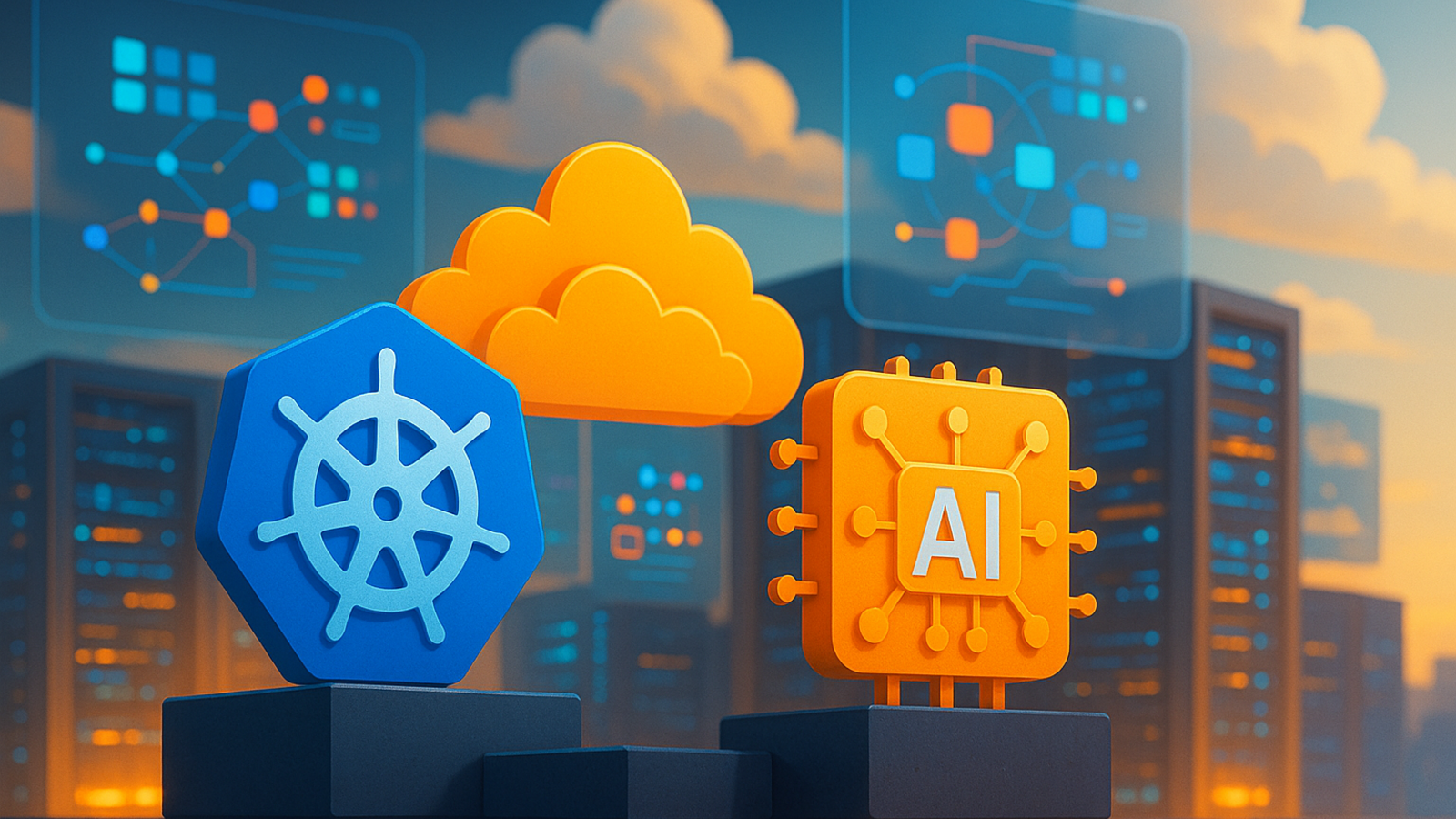
The Kubernetes ecosystem is undergoing a profound transformation. What began as a container orchestration platform is now rapidly evolving into the foundational infrastructure layer for the AI and agentic era. From Google Cloud’s ambitious Agent Sandbox and Hypercluster announcements to the Kubernetes community’s own governance frameworks for AI-assisted development, the landscape in mid-2026 is defined by a single truth: Kubernetes is no longer just about running containers — it’s about running intelligence at scale.
The Agentic Revolution Lands on Kubernetes
The most significant development this quarter is the general availability of GKE Agent Sandbox, Google’s purpose-built execution environment for AI agents running on Kubernetes. Since its preview at KubeCon NA in November 2025, adoption has exploded — Google reports 16x growth in sandboxes on GKE in under five months, with major adopters like Langchain and Lovable deploying millions of agents into production.
Agent Sandbox addresses a critical gap in the agentic infrastructure stack: the need to safely execute untrusted code, tools, and entire agents without sacrificing performance. Built on gVisor kernel isolation — the same technology securing Google’s Gemini models — it delivers what Google calls “industry-leading speed and efficiency for fully isolated agents.” The numbers are impressive: 300 sandboxes per second, per cluster, at sub-second latency, with 90% of allocations completing in under 200 milliseconds.
Key capabilities in the GA release include:
- Pod Snapshots for suspending idle agents and resuming them in seconds, dramatically reducing compute waste during bursty agent workloads
- Warm Pool Integration with standby capacity buffers (suspended VMs) that replenish the warm pool at a fraction of the cost
- Pluggable Isolation supporting Kata Containers and other open-source sandbox technologies alongside gVisor
- Default-deny Network Policy ensuring agents operate in a zero-trust networking environment
Perhaps even more ambitious is the introduction of Agent Substrate, a new open-source project designed to handle what Google calls “ultra-scale agents” — workloads numbering in the tens to hundreds of millions of instances. Agent Substrate introduces a minimal control plane that pairs Agent Sandbox’s snapshotting capabilities with optimized scheduling designed to bypass some of Kubernetes’ limitations when handling millions of sub-second tool calls. As the project documentation notes, while standard Kubernetes is optimized for thousands of long-running services, Agent Substrate is built for “the chatter of millions of sub-second tool calls that would otherwise overwhelm a standard control plane.”
Scaling Beyond Imagination: GKE Hypercluster
Complementing the agent infrastructure push, Google Cloud Next ’26 unveiled GKE Hypercluster — a single, Kubernetes-conformant GKE control plane capable of managing millions of accelerators across 256,000 nodes spanning multiple Google Cloud regions. This represents a fundamental rethinking of how Kubernetes scales in the AI era.
The motivation is clear: as foundational AI models grow exponentially and GPU/TPU demand outstrips supply, organizations have resorted to fracturing their Kubernetes infrastructure into hundreds of disconnected clusters. Hypercluster unifies these into a single capacity reserve, using Google’s Titanium Intelligence Enclave — a software-hardened security engine providing hardware-attested, pod-level isolation that cryptographically seals proprietary model weights and prompts from even platform administrators.
Google also announced significant inference optimizations, including Predictive Latency Boost in GKE Inference Gateway (up to 70% time-to-first-token reduction through real-time capacity-aware routing) and automatic KV Cache tiering across RAM, Local SSD, and Cloud Storage. These capabilities leverage llm-d, which recently became an official CNCF Sandbox project.
AI Operations Come to EKS
While Google is building agent infrastructure, AWS is applying AI to Kubernetes operations itself. The AWS DevOps Agent, now generally available, brings autonomous incident investigation to Amazon EKS environments. The agent automatically begins investigating when alerts trigger, correlating signals across CloudWatch Logs, cluster states, pod logs, and cluster events to identify root causes and recommend remediation.
In a recent AWS blog post, engineers demonstrated how the DevOps Agent diagnosed an EKS API server performance degradation scenario — specifically 429 throttling and API Priority and Fairness (APF) seat exhaustion — by autonomously identifying a misbehaving controller, correlating CloudWatch audit logs with throttling patterns, and delivering targeted recommendations. For SRE teams managing production EKS environments, this represents a significant reduction in mean time to resolution (MTTR).
The agent integrates with CI/CD pipelines, observability tools, and communication platforms, and analyzes historical incidents to deliver proactive recommendations for infrastructure optimization. It’s a clear signal that AI-native operations are becoming table stakes for Kubernetes management at scale.
The Community Responds: Kubernetes AI Policy
While cloud providers race to build AI infrastructure on Kubernetes, the Kubernetes community itself is grappling with a different challenge: how to responsibly integrate AI into open-source development. In June 2026, the project published comprehensive guidelines for AI-assisted contributions, establishing what may become a model for other open-source projects navigating the same waters.
The Kubernetes AI policy is built on five pillars:
- Transparency First: Contributors must disclose when AI tools assist with a pull request
- Human Accountability: The human contributor remains fully responsible for every change; AI cannot be listed as a co-author
- CLA Enforcement: Co-author CLA checks are enabled to flag PRs where AI agents cannot solve contributor license agreements
- Human Engagement Required: Contributors must personally explain changes and respond to review comments — PRs where contributors rely on AI to respond will be closed
- Verification Obligations: AI-generated changes must be verified through code review, testing, and personal understanding
The community is also experimenting with AI code review tools. CodeRabbit has been rolled out to select projects including Agent-Sandbox, where maintainers are using AI spot-check reviews as a quality gate. Meanwhile, GitHub Copilot remains available to maintainers through CNCF-provided licenses, though its reliance on individual contributor licenses limits broader community adoption.
Security and Networking: BackendTLSPolicy Arrives in OpenShift
On the networking front, Red Hat OpenShift 4.22 introduces BackendTLSPolicy support in Gateway API, giving users the same level of secured traffic as OpenShift routes provide with re-encrypt termination. Championed by Red Hat in the upstream Gateway API community, BackendTLSPolicy specifies TLS configuration for the connection from gateway to backend pods — a critical capability for end-to-end encryption in modern Kubernetes ingress.
The feature supports flexible TLS validation through hostname SNI headers, subjectAltNames (SANs) for multi-certificate matching, and both custom CA certificates and well-known system certificates. Red Hat’s commitment to upstream-first development means features go through the Gateway API stable channel before landing in OpenShift, ensuring enterprise-hardened quality.
OpenShift Service Mesh 3.4 also arrived, updating Istio to 1.30 and Kiali to 2.27, with enhancements to sidecar-less ambient mode and AI-powered diagnostics via Red Hat OpenShift Lightspeed in technology preview.
Runtime Security: containerd Patches Critical CVEs
The container runtime layer also saw important security activity. containerd 2.3.2, released in mid-June, patched five CVEs including vulnerabilities in user-database file reads, checkpoint restore robustness, and reserved label propagation from image configs. The release also fixed a Windows data race when reading shim logs and improved image distribution resilience by allowing the last registry host to retry on transient network errors.
On the package management front, Helm v3.21.2 bumped Kubernetes client libraries to match the Kubernetes v1.36 release, ensuring compatibility with the latest upstream APIs. etcd v3.6.13 also shipped with continued stability improvements for Kubernetes’ critical backing store.
What This Means for Platform Engineers
The convergence of these developments paints a clear picture: Kubernetes is becoming the operating system for the AI era, and the pace of change is accelerating. Platform engineers should consider several strategic priorities:
- Evaluate agent infrastructure readiness. Whether through GKE Agent Sandbox, OpenShift’s evolving capabilities, or emerging open-source projects like Agent Substrate, organizations building agentic applications need secure, low-latency execution environments
- Plan for hyper-scale. GKE Hypercluster demonstrates that Kubernetes can manage millions of accelerators — but achieving this requires rethinking cluster architecture, security models, and operational practices
- Adopt AI-native operations. Tools like AWS DevOps Agent are just the beginning. Expect AI-powered incident response, capacity planning, and security analysis to become standard Kubernetes tooling
- Establish AI governance. The Kubernetes community’s AI policy offers a template. Organizations contributing to or maintaining open-source projects should develop similar frameworks
Sources
- Google Cloud — Agent Sandbox on GKE and Agent Substrate
- Google Cloud — What’s New in GKE at Next ’26
- Kubernetes Blog — Open Source Maintainership in the Age of AI
- AWS Containers Blog — Diagnose Kubernetes Control Plane Performance Issues with AWS DevOps Agent
- Red Hat — BackendTLSPolicy Expands Gateway API Transport Security
- containerd v2.3.2 Release Notes
- Helm v3.21.2 Release Notes
- etcd v3.6.13 Release Notes

