
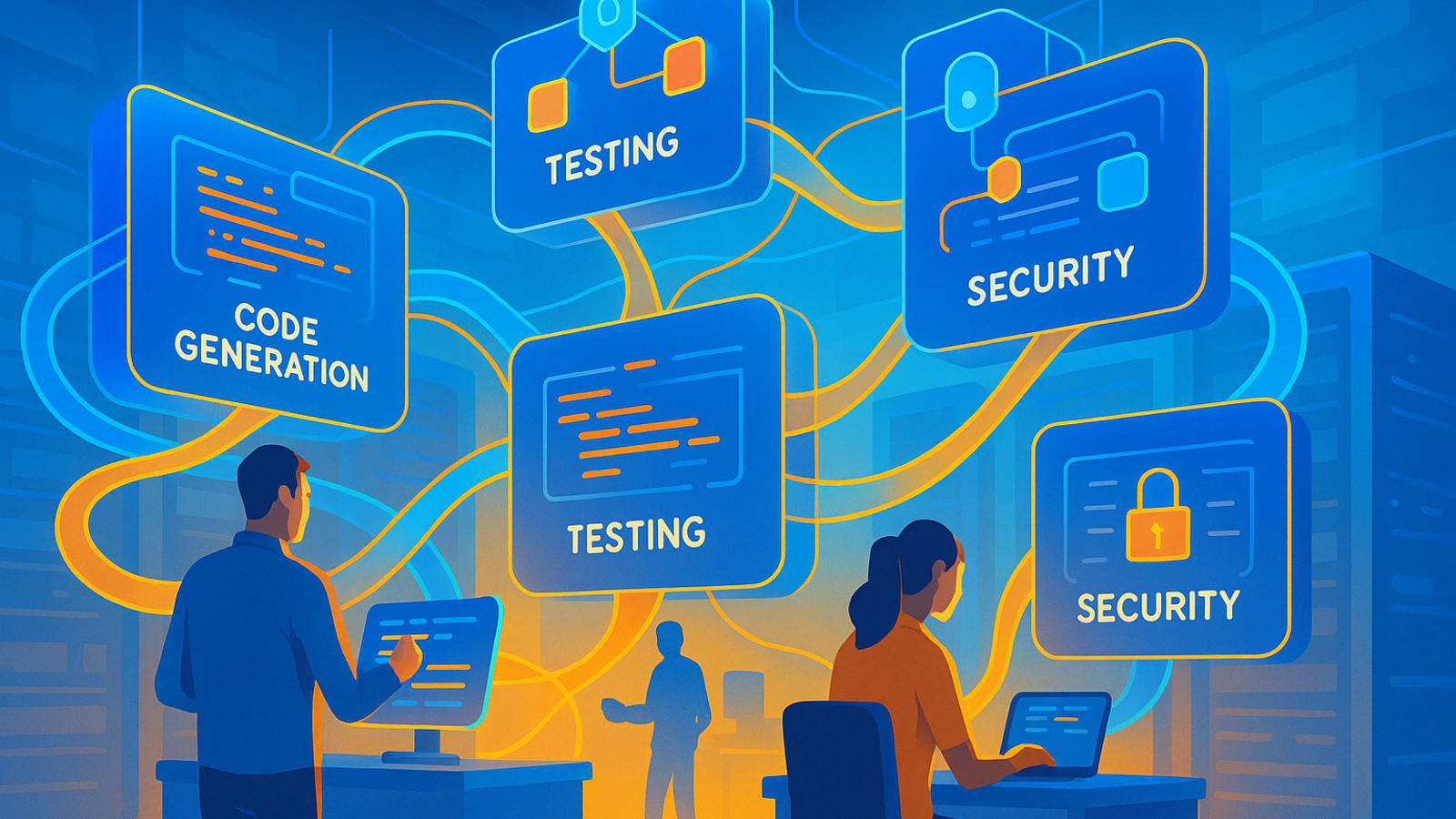
The transition from generative AI to agentic AI represents one of the most significant shifts in enterprise technology since cloud computing emerged. By the end of 2026, Gartner predicts that 40% of enterprise applications will embed AI agents, a massive leap from less than 5% in 2025. This isn’t just another technology trend—it’s a fundamental reimagining of how software is built, deployed, and maintained.
What Is Agentic AI?
Agentic AI refers to autonomous systems capable of planning, reasoning, and executing multi-step tasks without constant human oversight. Unlike traditional AI assistants that respond to individual prompts, agentic systems can:
- Set their own goals based on high-level objectives
- Execute complex workflows across multiple tools and systems
- Self-correct and iterate when encountering obstacles
- Collaborate with other agents in multi-agent orchestration patterns
- Operate autonomously for extended periods, reporting outcomes asynchronously
The market is responding to this potential. Industry analysts project the agentic AI market will surge from $7.8 billion today to over $52 billion by 2030. This growth reflects not just technological advancement, but genuine enterprise demand for autonomous systems that can handle complex, knowledge-based work.
Multi-Agent Systems: The New Architecture
The most significant development in 2026 is the shift from single agents to orchestrated multi-agent systems. Organizations are now deploying dozens or even hundreds of specialized agents that collaborate on complex, long-running tasks.
Consider software development as an example. Instead of a single AI assistant helping a developer write code, modern multi-agent systems operate like autonomous development teams:
- Architecture Agent designs system structure and API contracts
- Code Agent implements features and handles refactoring
- Testing Agent generates test cases and validates coverage
- Security Agent scans for vulnerabilities and compliance issues
- DevOps Agent manages deployments, monitoring, and incident response
AWS validated this direction at re:Invent 2025 by announcing “frontier agents” including Kiro for autonomous coding, along with dedicated security and DevOps agents. These agents maintain state, log actions, and operate within policy guardrails—enabling genuinely autonomous workflows that complement human engineering teams.
The Framework Landscape
Several frameworks have emerged as leaders in the multi-agent orchestration space:
LangGraph
LangChain remains the most widely adopted agentic framework, with over 126,000 GitHub stars. LangGraph, its graph-based extension, enables cyclical workflows where agents can revisit previous steps and adapt to changing conditions. This makes it ideal for complex, stateful processes requiring precise control over every state transition. Production implementations typically require 60+ lines of code but offer explicit control over agent behavior.
CrewAI
CrewAI takes a role-based approach to multi-agent teams. It gets workflows running in under an hour with approximately 20 lines of code, making it popular for rapid prototyping. The framework abstracts agent orchestration through a “crew” metaphor, where agents with specific roles collaborate toward shared objectives.
Microsoft AutoGen
AutoGen focuses on autonomous task execution with minimal setup. It emphasizes conversational agent patterns where multiple agents can negotiate, debate, and reach consensus on solutions. This framework excels in scenarios requiring exploration of alternative approaches.
Google Agent Development Kit (ADK)
Google’s ADK offers native support for the Agent-to-Agent (A2A) protocol, enabling communication between agents from different frameworks. This interoperability is crucial as organizations deploy heterogeneous agent ecosystems.
The A2A Protocol: Interoperability Standard
In April 2025, Google introduced the Agent2Agent (A2A) protocol, an open standard for AI agent interoperability. By June 2025, it was donated to the Linux Foundation, and by 2026, over 150 organizations had adopted it.
A2A complements Anthropic’s Model Context Protocol (MCP) by focusing on agent-to-agent communication rather than tool context. While MCP standardizes how agents interact with external tools and data sources, A2A enables agents to:
- Discover other agents and their capabilities
- Exchange structured information securely
- Coordinate actions across framework boundaries
- Delegate subtasks to specialized agents
As a universal, decentralized standard, A2A acts as the “public internet” for AI agents—allowing them to interoperate regardless of their underlying framework or vendor.
Practical Applications in Software Development
The most mature agentic AI deployments are occurring in software development and infrastructure management:
Autonomous Coding
Cursor 2.0 enables running up to eight agents in parallel on a single prompt, using git worktrees or remote machines to prevent file conflicts. Each agent operates in its own isolated codebase copy, exploring different implementation approaches simultaneously.
Factory AI’s “Droids” automate coding, testing, and deployment for startups and enterprises. These agents don’t just write code—they understand project structure, maintain consistency with existing patterns, and handle the entire development lifecycle.
DevOps Automation
AI agents are revolutionizing DevOps by automating testing, deployment, and monitoring. Platforms like Harness use contextual insights and agentic workflows to detect and mitigate risks from build through post-deployment. Agents can:
- Analyze code for vulnerabilities before deployment
- Predict infrastructure issues based on patterns
- Automatically revert problematic deployments
- Scale resources based on predicted demand
IBM’s “Shifting Everywhere” approach uses agentic AI to extend DevOps automation beyond traditional boundaries, enabling human-in-the-loop development where agents work alongside engineers to meet goals faster.
Security Integration
Security agents now operate continuously, scanning codebases, monitoring infrastructure, and responding to threats. AWS launched dedicated security agents that work autonomously to identify vulnerabilities, apply patches, and maintain compliance posture.
Self-Improving Systems
The frontier of agentic AI is recursive self-improvement. At ICLR 2026, researchers discussed how LLM agents now rewrite their own codebases or prompts to optimize performance. Google’s AlphaEvolve demonstrated this capability by designing advanced algorithms through iterative self-improvement.
The standard architecture for self-improving agents in 2026 follows a layered recursive stack:
- Observation Layer: Monitor performance metrics and environment feedback
- Reflection Layer: Analyze failures and identify improvement opportunities
- Meta-Reasoning Layer: Update internal strategies and prompt templates
- Execution Layer: Implement changes and validate improvements
While full recursive self-improvement across the entire AI stack without human oversight remains theoretical, narrow versions are already active—yielding approximately 20% performance gains in specialized domains.
Security Challenges
As agentic AI adoption accelerates, security has emerged as a critical concern. In December 2025, OWASP published specific guidance for autonomous AI agents, identifying threats including:
- Goal Hijacking: Attackers manipulate agent objectives
- Tool Misuse: Agents exploited to perform unauthorized actions
- Identity Abuse: Compromised agent credentials used for lateral movement
- Memory Poisoning: Corruption of agent learning and decision-making
- Cascading Failures: Errors propagating across interconnected agent systems
In response, Microsoft released an open-source Agent Governance Toolkit providing runtime security for AI agents. NIST launched the AI Agent Standards Initiative in February 2026 to establish interoperable security standards. And the federal government issued an RFI in January 2026 seeking input on security considerations for AI agent systems.
The core principle is that autonomous agents require autonomous security—systems capable of detecting when an agent is behaving abnormally and preventing attackers from moving laterally to access other infrastructure and databases.
Enterprise Adoption Patterns
Organizations are approaching agentic AI adoption with measured pragmatism:
Phase 1: Pilot Projects (2025-2026) – 25% of companies using generative AI launched agentic pilots in 2025, focusing on contained use cases like code review or test generation.
Phase 2: Production Integration (2026-2027) – Organizations embed agents into existing workflows, with human oversight at critical decision points. This is projected to reach 50% adoption by 2027.
Phase 3: Autonomous Operations (2027+) – Full autonomous agents operating with minimal human intervention for well-defined domains.
Low-code and no-code AI agent platforms are accelerating this adoption by removing traditional barriers to AI development. Platforms like Langflow enable visual agent orchestration, while n8n’s agent-to-agent capabilities expand orchestration avenues for non-technical users.
The Human Role
Despite the autonomous capabilities, human oversight remains essential. The most successful implementations follow a “human-in-the-loop” pattern where:
- Humans define high-level objectives and constraints
- Agents handle execution and iteration
- Humans review critical decisions and exceptions
- Agents learn from human feedback to improve future performance
Business leaders, product teams, and engineers must collaboratively establish parameters so AI agents can’t—and shouldn’t—operate without any human involvement. Rather, agentic AI enables human-AI collaboration where each contributes their strengths.
Looking Ahead
The trajectory is clear: agents are evolving from assistants to collaborators to autonomous teammates. Organizations that begin experimenting with multi-agent frameworks today will be positioned to capitalize on the productivity gains as the technology matures.
Key indicators to watch include:
- Agent Protocol Adoption – Widespread A2A and MCP implementation
- Framework Consolidation – Which orchestration platforms achieve enterprise dominance
- Security Maturity – Development of standardized agent security practices
- Regulatory Guidance – How governments address autonomous AI systems
The question is no longer whether agentic AI will transform software development and infrastructure management—it’s how quickly organizations can adapt their processes, security models, and workforce development to capitalize on this shift. Those who view agentic AI merely as enhanced automation will miss the larger transformation: the emergence of genuinely autonomous digital workers that augment and extend human capabilities.

