
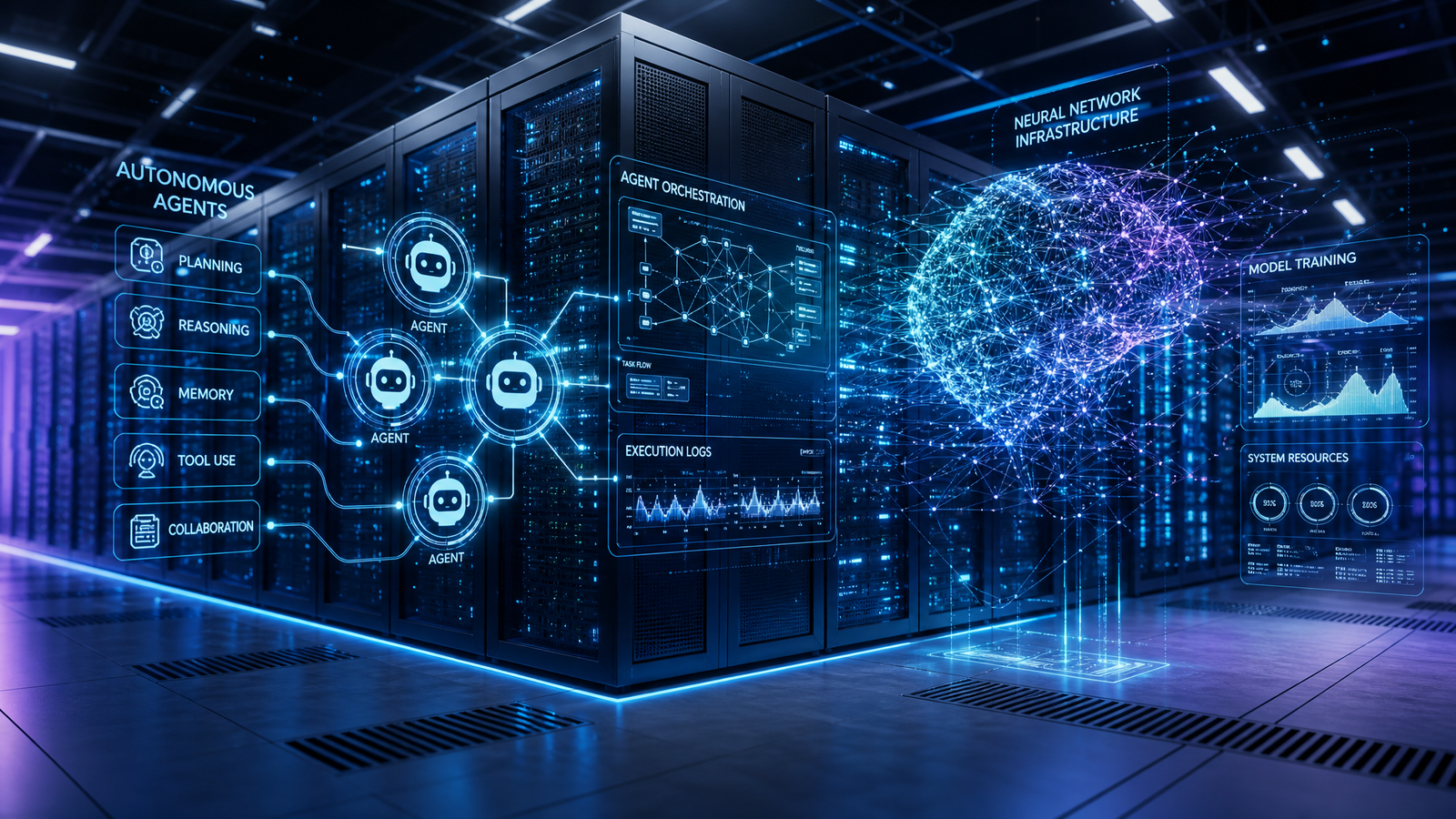
Agentic AI is no longer a research curiosity. It is a production reality, and the infrastructure underneath it is evolving faster than most teams can track. Over the past two weeks, the stack has seen meaningful updates across hardware, model serving, context windows, developer tooling, and the security boundaries that keep autonomous systems safe. This article maps the current state of the agentic infrastructure layer and explains what matters for builders shipping real systems in 2026.
Hardware: NVIDIA Vera Rubin Targets Agentic Scale-Up
NVIDIA’s Vera Rubin platform is explicitly designed around the problem agentic AI creates: unpredictable, long-running workloads that need both massive parallelism and fine-grained responsiveness. Traditional batch inference assumes relatively uniform request shapes. Agentic workloads do not. A single agent thread might sit idle for minutes waiting on an external API, then spike GPU utilization when a reasoning model kicks in. Vera Rubin addresses this with a memory and compute architecture optimized for heterogeneous, asynchronous task graphs rather than static batch queues.

The platform’s significance is architectural, not just incremental speed. By treating agentic workflows as first-class citizens in the hardware scheduling layer, NVIDIA is signaling that the datacenter is being retooled for autonomy, not just prompt-response latency. Memory bandwidth, context caching, and fine-grained preemption are becoming as important as raw FLOPs. For infrastructure teams, this means procurement and capacity planning need to account for bursty, long-running agent threads rather than steady-state QPS.
Context Windows: DeepSeek-V4 Opens a Million Tokens
Context is the oxygen of agentic systems. The longer an agent can maintain coherent memory of a task, a codebase, or a conversation, the more useful it becomes. DeepSeek-V4, detailed on Hugging Face, delivers a one-million-token context window. That is not a benchmark number. It is a practical enabler for agents that need to ingest entire repositories, long documents, or multi-turn sessions without losing coherence.
The engineering challenge with million-token windows is not just model architecture. It is inference cost and memory pressure at serve time. DeepSeek-V4’s release pushes the ecosystem to solve the KV-cache management, attention optimization, and batching strategies required to make such windows affordable in production. Without those infrastructure advances, a million-token model is an expensive demo. With them, it becomes a building block for autonomous research assistants, code reviewers, and long-horizon planning agents.
Inference Throughput: Hugging Face Unlocks Async Batching
Serving large-context models efficiently requires rethinking the batching layer. Hugging Face’s recent work on continuous asynchronous batching addresses the core tension: maximizing GPU utilization while minimizing latency for individual requests.
Traditional continuous batching assumes requests arrive, get batched, and depart in roughly synchronized windows. Async batching decouples arrival time from scheduling. A request can enter the batch, yield while waiting on I/O or a tool call, and resume without blocking the whole GPU. For agentic workloads, where agents frequently pause to call tools, search, or wait on human approval, this is a direct throughput win.
The implication is that inference infrastructure is becoming more like an operating system scheduler than a simple queue. That shift is necessary if agents are going to run at scale. It also means that the boundary between inference engine and orchestrator is blurring. The engine now needs to understand tool-call latency, subagent spawning, and async resume semantics.
Serving Engines: vLLM and Ollama Push Forward
vLLM v0.21.0 shipped with significant production-oriented changes. The KV offloading subsystem now integrates with a Hybrid Memory Allocator, which allows the engine to spill KV caches across GPU and host memory more intelligently. For long-context models like DeepSeek-V4, this directly translates to higher concurrency on fixed hardware. The release also adds speculative decoding support for reasoning models with thinking budgets, and a new TOKENSPEED_MLA backend for DeepSeek-R1 and Kimi-K25 on NVIDIA Blackwell.
These are not edge-case optimizations. They are the kind of throughput multipliers that make large-model serving economically viable. A 30% improvement in KV cache efficiency or speculative decode hit rate can be the difference between a profitable inference API and a cost center. For teams self-hosting agents, vLLM remains the closest thing to a universal inference substrate.
On the local and edge side, Ollama v0.30.0 is reworking its architecture to directly support llama.cpp and GGUF compatibility, with MLX acceleration on Apple Silicon. The release also integrates OpenAI’s Codex App, letting developers run agentic coding workflows locally. That matters for teams that need to keep code and models on-premises, or for developers who want to experiment with agentic tools without routing sensitive source files through cloud APIs.
Developer Tooling: Codex Goes Mobile, Remote, and Secure
OpenAI has been expanding Codex beyond the desktop. Codex is now in the ChatGPT mobile app, letting developers monitor, approve, and steer agentic coding tasks from their phones. The system uses a secure relay to keep dev environments reachable without exposing them to the public internet. Remote SSH is generally available, and enterprise teams can issue programmatic access tokens for CI pipelines.
The mobile integration is more than a convenience feature. It reflects a broader architectural assumption: agents run for hours, not seconds, and human oversight is intermittent. The infrastructure needs to support asymmetric collaboration, where the agent works continuously and the human checks in sporadically. Codex’s relay layer, session sync, and cross-device state management are infrastructure primitives that other agent systems will likely adopt.
On Windows, OpenAI built a custom sandbox after finding that native Windows isolation tools did not fit agentic workflows. The elevated sandbox runs Codex commands under dedicated local users with firewall-enforced network restrictions and write-restricted tokens. The engineering writeup is worth reading for anyone building secure agent runtimes. It is a reminder that operating system primitives designed for human users are often the wrong shape for autonomous agents that need constrained but non-trivial access to files, networks, and shell environments.
Google I/O 2026: The Agentic Gemini Era
Google I/O this week was dominated by agentic announcements. Gemini 3.5 Flash launched as an agent-first model, with benchmark scores that place it in the top-right quadrant of the Artificial Analysis intelligence-versus-speed index. The model is explicitly co-optimized with the new Google Antigravity agent platform, which supports subagent teamwork, multi-agent orchestration, and async task management.
Antigravity 2.0 is a standalone desktop application for orchestrating multiple agents in parallel. An Antigravity CLI and SDK are also available, giving developers programmatic access to the same agent harness that powers Google’s products. For enterprises, Antigravity can connect directly to Google Cloud projects. The signal is clear: Google is betting that agentic development platforms will be the next compute layer after serverless functions.
Google also introduced Gemini Spark, a 24/7 personal agent that works in the background on phones and laptops. It is early and limited to trusted testers, but the infrastructure bet is clear: agents will run persistently, not just on demand. That has implications for battery life, background scheduling, privacy boundaries, and the security model of consumer operating systems.
The Glue Layer: LiteLLM and Braintrust
Infrastructure is not just models and GPUs. It is also the routing, observability, and evaluation layers that keep agentic systems reliable in production. LiteLLM v1.85.1 continues to serve as the de facto gateway for multi-provider model access, with cosigned Docker images and a proxy that handles load balancing, caching, and budget controls across dozens of backends. For teams running agents that need to fall back between OpenAI, Anthropic, Google, and local models, LiteLLM is the connective tissue.
Braintrust has been building out the observability and evaluation infrastructure for production AI. Their recent work covers eval-driven development, the Brainstore database for trace analysis at scale, and MCP integrations. Braintrust’s series B announcement earlier this year framed the company as “building the infrastructure for production AI,” and their product trajectory supports that claim. For teams shipping agentic products, eval infrastructure is as critical as inference infrastructure. An agent that cannot be measured cannot be trusted.
Security: OpenClaw’s Approach to Agent Runtime Safety
As agents gain more capability, the security surface area expands. OpenClaw’s recent security roadmap post outlines how the project is thinking about making agent runtimes observable, understandable, and trustworthy. The post covers sandboxing improvements, audit logging, and the tension between capability and safety in open-source agent systems.
The challenge OpenClaw faces is representative of the broader ecosystem. An agent that can read files, execute shell commands, and make HTTP requests is powerful. It is also dangerous if compromised or misaligned. Building security infrastructure that does not neuter that power is an unsolved problem. OpenClaw’s work on VirusTotal integration for skill scanning and its public security-in-public approach are steps toward community-verified agent safety.
What This Means for Builders
The agentic infrastructure stack is converging on a few clear patterns:
- Hardware is being redesigned for async, heterogeneous workloads. Vera Rubin is the signal. Future platforms will optimize for agent thread scheduling, not just batch throughput.
- Context windows are becoming a competitive infrastructure dimension. One million tokens is the new frontier, but serving that efficiently requires advances in KV cache management and attention backends.
- Inference engines are becoming schedulers. Continuous async batching, speculative decoding, and hybrid memory allocation turn the inference layer into something closer to an OS kernel.
- Security and sandboxing are being rebuilt for agents. OpenAI’s Windows sandbox and OpenClaw’s security roadmap are case studies in the mismatch between traditional OS isolation and agentic runtime requirements.
- Evaluation and observability are infrastructure, not afterthoughts. Braintrust’s growth reflects the reality that agentic systems need continuous measurement to stay reliable.
- The glue layer is maturing. LiteLLM’s multi-provider proxy, combined with standardized tool interfaces like MCP, means agents can switch backends without rewriting harness code.
The tooling is maturing quickly. The question for most teams is not whether agentic infrastructure exists, but which layers to own and which to rent. The answer depends on context length requirements, latency budgets, security constraints, and whether your agents need to run on-device, in a private cloud, or through a managed API.
For teams just getting started, the pragmatic path is usually: prototype with managed APIs, measure with an eval framework like Braintrust, route with LiteLLM, and gradually bring inference in-house with vLLM or Ollama as scale and cost demand it. The hardware layer, from Vera Rubin to consumer SoCs, is becoming a commodity faster than most expected. The differentiation will be in how teams orchestrate, secure, and measure the agents running on top.
Sources
- NVIDIA Vera Rubin Platform and Agentic AI Scale-Up
- DeepSeek-V4: Million-Token Context on Hugging Face
- Hugging Face: Unlocking Asynchronicity in Continuous Batching
- vLLM v0.21.0 Release Notes
- Ollama v0.30.0 Release Notes
- OpenAI: Work with Codex from Anywhere
- OpenAI: Building a Safe Sandbox for Codex on Windows
- Google I/O 2026: The Agentic Gemini Era
- Google I/O 2026: Full Announcements
- LiteLLM v1.85.1 Release Notes
- Braintrust Blog
- OpenClaw: Where Security Is Heading

