OpenClaw 2026.9.3 Puts Update Safety At The Center Of Agent Operations
OpenClaw 2026.9.3 shows why safer updates, bounded repair, and runtime visibility are becoming core requirements for agentic AI platforms.
Browse the latest reporting and analysis by topic.

OpenClaw 2026.9.3 shows why safer updates, bounded repair, and runtime visibility are becoming core requirements for agentic AI platforms.

vLLM 0.29.0 makes Model Runner V2 the default, showing how open inference engines are shifting from model compatibility toward production runtime discipline.

OpenAI’s GPT-5.6 Sol quantum-computing example points to the next phase of agentic AI: controlled operating loops that connect reasoning, tools, evaluation, and rollback.

OpenAI’s GPT-6 Astra launch is best understood as an enterprise infrastructure move: a premium model tier built for long-context, tool-connected, end-to-end agentic work.

Hugging Face's funes release shows why durable, inspectable memory is becoming core infrastructure for coding agents rather than a prompt-level convenience.

Google's latest Managed Agents update shows that agentic AI is maturing into a governed execution layer built around hooks, budgets, scheduling, and resumable work.

Prometheus 3.13.3 is a patch release, but its security, PromQL, discovery, shutdown, and TSDB fixes show why observability infrastructure needs first-class maintenance.

Karmada's CNCF graduation signals that multi-cluster Kubernetes orchestration is moving into production maturity as enterprises manage AI workloads, hybrid capacity, and regional resilience.

Kubernetes v1.37 promotes KubeletInUserNamespace to beta, giving platform teams a more practical path to evaluate rootless node components as part of node hardening.

A new CNCF argument about CPU-and-GPU coordination points to the next real job for cloud-native platform teams: orchestrating the handoffs around accelerators, not just procuring more of them.

OpenTelemetry's Go Logs API and SDK release candidate signals that unified, vendor-neutral logs are moving from aspiration to practical architecture for Kubernetes and platform teams.

Kubernetes 1.37 brings Pod Certificates and Cluster Trust Bundles to GA, moving certificate-based workload identity closer to the core platform and raising the bar for native mTLS operations.

GitHub's managed Copilot sandbox for JetBrains shows how AI coding assistants are becoming governed developer infrastructure.

CircleCI’s Smarter Testing release gives platform teams a practical model for faster CI: selected tests on branches, full validation at gates, smarter splitting, and bounded flaky-test recovery.

GitHub’s new support for multiple npm trusted publishing configurations gives DevOps teams a cleaner way to split stable, prerelease, and staging release paths without falling back to long-lived registry tokens.

GitHub Enterprise Live Migrations gives platform teams a practical way to move busy repositories to the cloud without treating cutover as a major outage event.

CircleCI's Smarter Testing launch highlights a new platform bottleneck: AI can speed up coding, but CI still has to deliver fast, relevant confidence.

Backstage v1.54.0 introduces native MCP action support, agent-friendly catalog refresh, audit logging for Kubernetes and MCP operations, and catalog diff sync—positioning developer portals as operational control planes for agent-driven workflows.

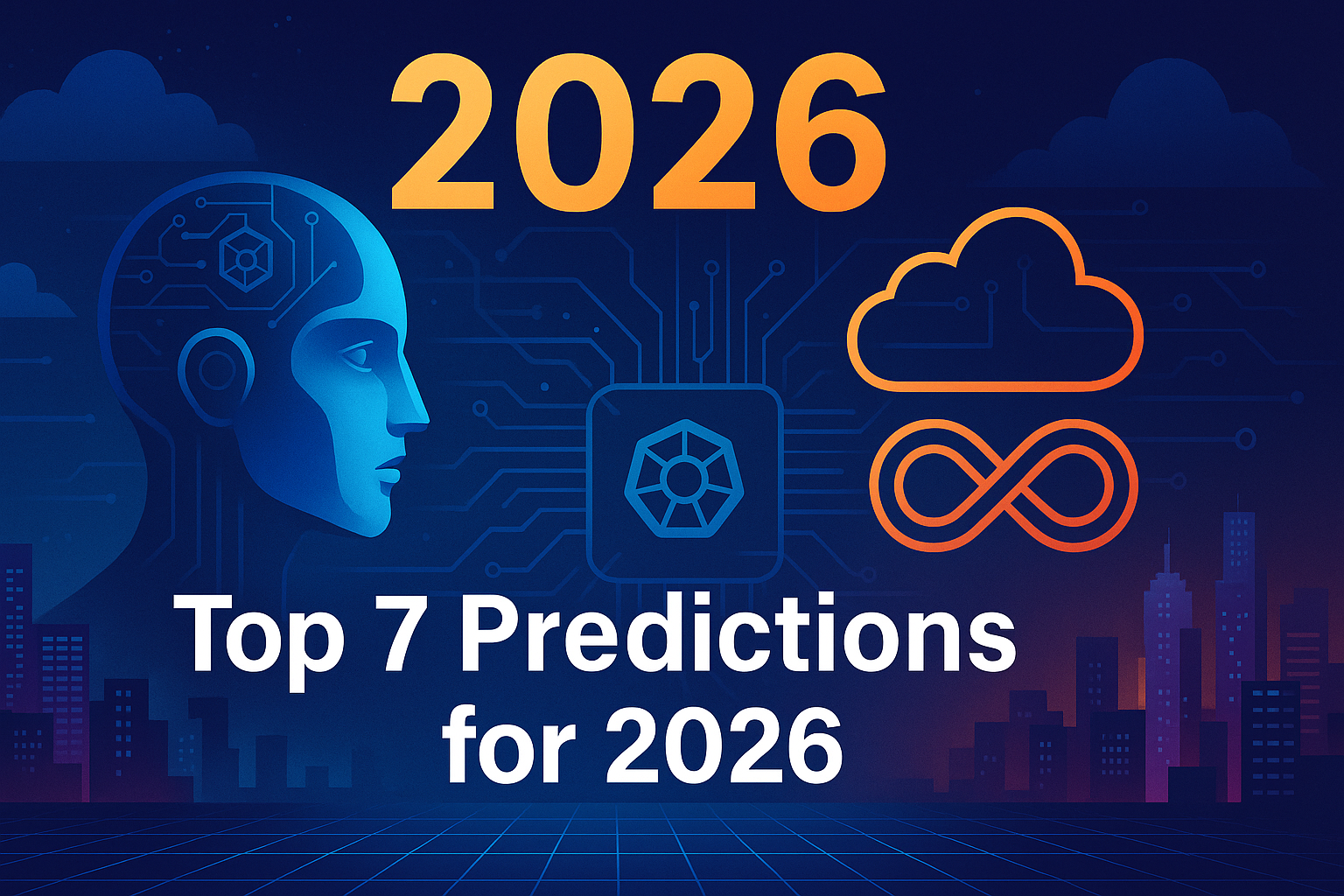
As 2025 comes to an end, one clear theme is emerging across the industry: AI is no longer experimental—it’s becoming the foundation of how modern organizations build, secure, and scale technology. Drawing from the latest VMblog coverage and industry analysis, here are seven predictions for 2026 that reveal where Cloud-Native, DevOps, and AI-driven enterprises are […]

Cloudflare launches a full platform for autonomous AI agents, DDoS attacks exceeding 1 Tbps surge 519%, and OpenCost introduces Kubernetes inference cost tracking — the cloud-native stack is being rebuilt for an agentic, AI-driven world.

Agentic AI stopped being a prototype this week. OpenAI shipped enterprise phone-support agents. Meta released a 30B-parameter local model. Google expanded managed agents with hooks and budget controls. And an AI agent autonomously chained zero-day exploits to compromise Hugging Face infrastructure. A field report from the front lines.

AI agents now author Terraform, trigger CI/CD, and manage Kubernetes deployments autonomously. But speed without governance is a faster way to break production. Here's how the platform engineering community is building control planes to keep agentic infrastructure safe.

Google Cloud launches GKE Agent Sandbox GA and open-sources Agent Substrate — a new layer for ultra-scale agent infrastructure. Plus: GKE Inference Gateway benchmarks, AWS zone-aware routing, containerd v2.3.3, etcd v3.7.1, and DRA Device Taints graduating to GA.

Five critical vulnerabilities dubbed IngressNightmare affect Kubernetes NGINX Ingress Controller versions prior to 1.12.1, with CVE-2025-1974 enabling unauthenticated RCE. Patch immediately.

Canonical’s new AppArmor guidance makes the priority clear: apply both kernel updates and userspace mitigations, especially where attacker-controlled containers may run. The practical lesson for platform teams is that host hardening advice is only useful if it becomes an explicit patch-and-reboot workflow with exposure checks.