
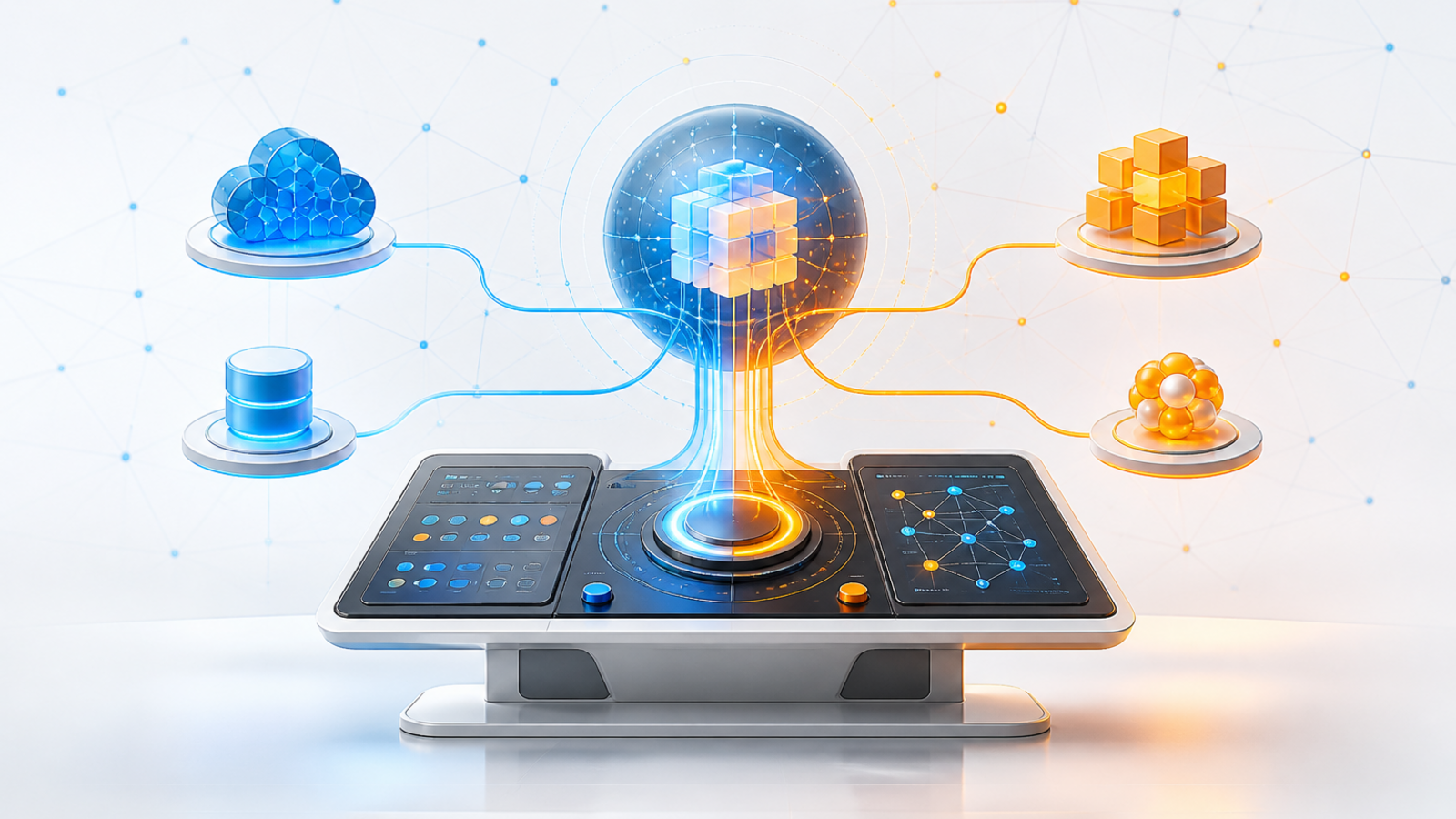
The LLM market is no longer organized around a single flagship model per vendor. The current pattern in official model catalogs is a more operational one: providers are splitting their portfolios into tiers for reasoning, speed, multimodal work, voice, code, search, document parsing, and domain-specific use cases. For teams building applications on top of LLMs, that change is more important than any one benchmark jump. The practical question has shifted from “which model is best?” to “which model should be routed to which part of the system?”
This is visible across the major model menus. OpenAI’s model page leads with a flagship family for complex reasoning and coding, while also separating efficient high-volume models, cybersecurity models, life sciences models, image models, realtime voice models, transcription models, and speech generation models. Anthropic presents Claude as a family with named tiers and explicit model IDs, including Opus, Sonnet, Haiku, and Fable variants. Google’s Gemini API docs now describe a ladder that spans Flash, Flash-Lite, Pro, Live, TTS, image, and transcription models. xAI’s Grok catalog positions Grok 4.7 as its main model for code and general work, but also carves out image, video, and voice APIs. Mistral, DeepSeek, Cohere, and Ollama show the same broad direction from different angles.
The result is a market where the core unit of adoption is increasingly a model portfolio, not a model. The winning engineering teams will be the ones that treat LLM choice as infrastructure: measured, routed, versioned, monitored, and changed deliberately.
The flagship is becoming a routing target, not the whole strategy
Flagship models still matter. They set the high-water mark for difficult reasoning, complex coding, long-horizon planning, and multimodal work. OpenAI describes its top general model as built for “the hardest end-to-end work.” Anthropic’s Claude docs steer users through a current lineup that includes higher-capability and faster tiers. Google describes Gemini 3.8 Flash as engineered for long-horizon software engineering, autonomous agents, and complex enterprise workflows. xAI calls Grok 4.7 its flagship model for code, agentic tool calling, low hallucination, and configurable reasoning.
But the flagship is no longer the default answer to every production question. It is too expensive, too slow, or too scarce for many workloads. A customer support flow may need a fast classification step, a retrieval step, a draft response, a policy check, and an escalation summary. A code agent may need a cheap model to triage files, a stronger model to modify a risky module, and a specialized judge to evaluate a patch. A voice agent may need low-latency audio handling before a deeper reasoning pass is even useful.
That is why official catalogs now emphasize model selection. The model menu itself has become part of the product. Providers are not just saying “use our best model.” They are teaching developers to divide applications into work units and match each unit to a model with the right latency, context window, modality, cost, and reliability profile.
Google’s Gemini catalog shows the tiering pattern clearly
Google’s Gemini API model list is one of the clearest examples of how dense the model map has become. The current docs describe Gemini 3.8 Flash as the latest Flash model, Gemini 3.8 Live for low-latency voice agent experiences, Gemini 3.8 Live Extended Thinking for voice interactions that need more background reasoning, Gemini 3.8 Flash TTS and Flash-Lite TTS for production voice output, and legacy or previous-generation Flash models for older integrations. The same page still documents Gemini 2.5 Flash, Flash-Lite, and Pro for users who actively used them before, while recommending newer models for new projects.
That kind of catalog is easy to read as clutter. In practice, it reflects how LLM applications are being built. A real product may need multiple model classes inside one user journey. The voice layer must respond quickly enough to feel conversational. The reasoning layer may need extra time and tokens. The image layer may use a separate model entirely. The transcription layer has its own quality and latency constraints. The text model that writes a final answer may not be the model that listens, speaks, searches, extracts, or moderates.
For developers, the important signal is not that Gemini has many names. It is that the platform expects developers to assemble systems from multiple model capabilities. That expectation is spreading across the industry.
OpenAI and Anthropic are pushing users toward model governance
OpenAI’s public model catalog also points toward a portfolio mindset. The page separates flagship reasoning models, efficient models for focused high-volume tasks, specialized models for cybersecurity and life sciences, image generation and editing models, realtime speech and translation models, text-to-speech models, and transcription models. It also foregrounds model selection, model providers, tool and data controls, workspace access, and model availability. Those are governance topics as much as product topics.
That framing matters because enterprises rarely adopt a single LLM in isolation. They need to know which models are approved for which teams, which tools a model can call, whether a model is available in a given workspace, how data is controlled, and how to migrate when aliases or versions change. As model catalogs expand, the administrative surface becomes part of the developer experience.
Anthropic’s Claude docs make a similar point through versioning and lifecycle structure. The current Claude overview lists named model families, Claude API IDs, aliases, cloud platform IDs, model cards, upgrade guidance, model deprecations, and lifecycle status. That is the vocabulary of production software, not a one-off demo. A team choosing Claude is not just choosing a personality or benchmark score. It is choosing a versioning contract and an upgrade path.
This is where LLM work starts to look more like database, cloud, and dependency management. Teams need pinned versions for repeatability, aliases for smoother upgrades, retirement schedules for planning, and programmatic model metadata for automation. The model is not just an endpoint. It is a dependency with lifecycle risk.
Open-weight and specialist providers reinforce the same shift
The tiering trend is not limited to the largest proprietary labs. Mistral’s model docs divide the portfolio into generalist models, OCR models, audio models, code models, embedding models, moderation models, and other specialist models. It highlights Mistral Medium 3.5 for agentic and coding use cases, Mistral Small 4 as an efficient hybrid model, Mistral Large 3 as an open-weight general-purpose multimodal model, and dedicated services for OCR, audio, code completion, embeddings, and safety.
Cohere’s model docs are similarly task-oriented. The Command family covers generation, reasoning, vision, translation, and retrieval-adjacent uses, while Cohere separately documents embedding, reranking, parsing, and transcription models. DeepSeek’s pricing page currently distinguishes deepseek-flash and deepseek-v4-pro, while noting that older names are still accepted but served by newer models. Ollama’s Qwen3 library page highlights a broad open model family with dense and mixture-of-experts variants, including small local models and larger MoE models for reasoning, coding, and agent tasks.
Together, those catalogs show that the old closed-versus-open framing is incomplete. The competitive dimension is not simply proprietary quality against open accessibility. It is also portfolio coverage. Can a provider cover fast inference, local deployment, tool use, coding, retrieval, image understanding, speech, document extraction, moderation, and predictable lifecycle management? Can developers mix those capabilities without building a fragile patchwork?
The next abstraction is the model router
Once model catalogs become portfolios, routing becomes a first-class engineering problem. A model router can be as simple as a few rules in application code, or as complex as a policy engine that considers request type, user tier, latency budget, data sensitivity, token count, model availability, and fallback behavior. Either way, the routing layer becomes where cost, quality, and reliability tradeoffs are enforced.
Teams already do this informally. They send easy classification work to a cheaper model, hard reasoning work to a stronger one, embeddings to a retrieval model, speech to an audio model, and moderation to a safety model. The risk is that these decisions often live in scattered code paths and tribal knowledge. As catalogs expand, that approach becomes brittle.
A mature LLM architecture should make routing visible. Engineers should be able to answer which model handles each step, why that model was chosen, what it costs, what happens when it fails, and how its outputs are evaluated. Product leaders should be able to see whether a quality improvement requires a better prompt, a different model tier, a larger context window, or a new workflow design. Security teams should be able to audit which model had access to which data and tools.
Versioning is now part of model quality
The versioning details in model docs are not housekeeping. They directly affect application behavior. xAI’s docs explain the difference between model aliases such as a latest alias and specific dated releases. Anthropic documents API IDs, aliases, platform-specific IDs, and model deprecations. DeepSeek notes that legacy model names may still be accepted even when requests are served by newer models. Google marks older models as legacy or previous generation while keeping some available for existing users.
For small experiments, a moving alias can be convenient. For production systems, silent model movement can change output style, latency, cost, tool-use behavior, refusal behavior, or benchmark performance. That does not mean aliases are bad. It means teams need to decide where stability matters and where automatic upgrades are acceptable.
A practical pattern is to pin models for high-risk workflows, use aliases for low-risk or rapidly improving workflows, and run continuous evaluations across both. When a provider releases a stronger or cheaper tier, the evaluation suite should show whether the new model can replace an older one. Without that discipline, model upgrades become anecdotal: a few good demos, a few surprising regressions, and no clear decision record.
What engineering teams should change now
The immediate implication is that teams should stop treating model selection as a one-time choice. It should be a maintained part of the system design. A useful starting point is to inventory every LLM call in an application and classify it by job: classification, extraction, retrieval query rewriting, tool planning, code generation, final response writing, safety review, speech, image understanding, or document parsing.
From there, teams can assign model requirements to each job. Some calls need low latency. Some need a large context window. Some need deterministic formatting. Some need strong reasoning. Some need local or open-weight deployment. Some need official enterprise controls. Some can tolerate occasional retries; others sit directly in a user-facing path and must be fast and stable.
The third step is to make model lifecycle changes observable. Store model IDs with traces. Track latency, cost, error rates, fallback rates, and user-visible quality metrics by model. When a provider changes a default, retires a model, or releases a new tier, the team should know which workflows are affected before users do.
The broader market signal
The model catalog is becoming a map of where vendors think AI applications are going. The major labs are not only competing on frontier reasoning. They are competing on coverage: faster models for volume, stronger models for difficult work, speech models for realtime agents, image models for multimodal products, code models for software teams, safety models for governance, and specialized models for regulated or high-value domains.
That makes the market more complex, but also more useful. Developers have more ways to match capability to workload. Enterprises have more levers for cost control and risk management. Open-weight ecosystems have more room to compete where deployment control, customization, and local inference matter.
The main mistake is to keep evaluating LLMs as if the category were still a single leaderboard. The more durable question is architectural: how well does a model family help a team build, operate, and evolve an AI system? In 2026, that question is becoming the center of LLM strategy.

