
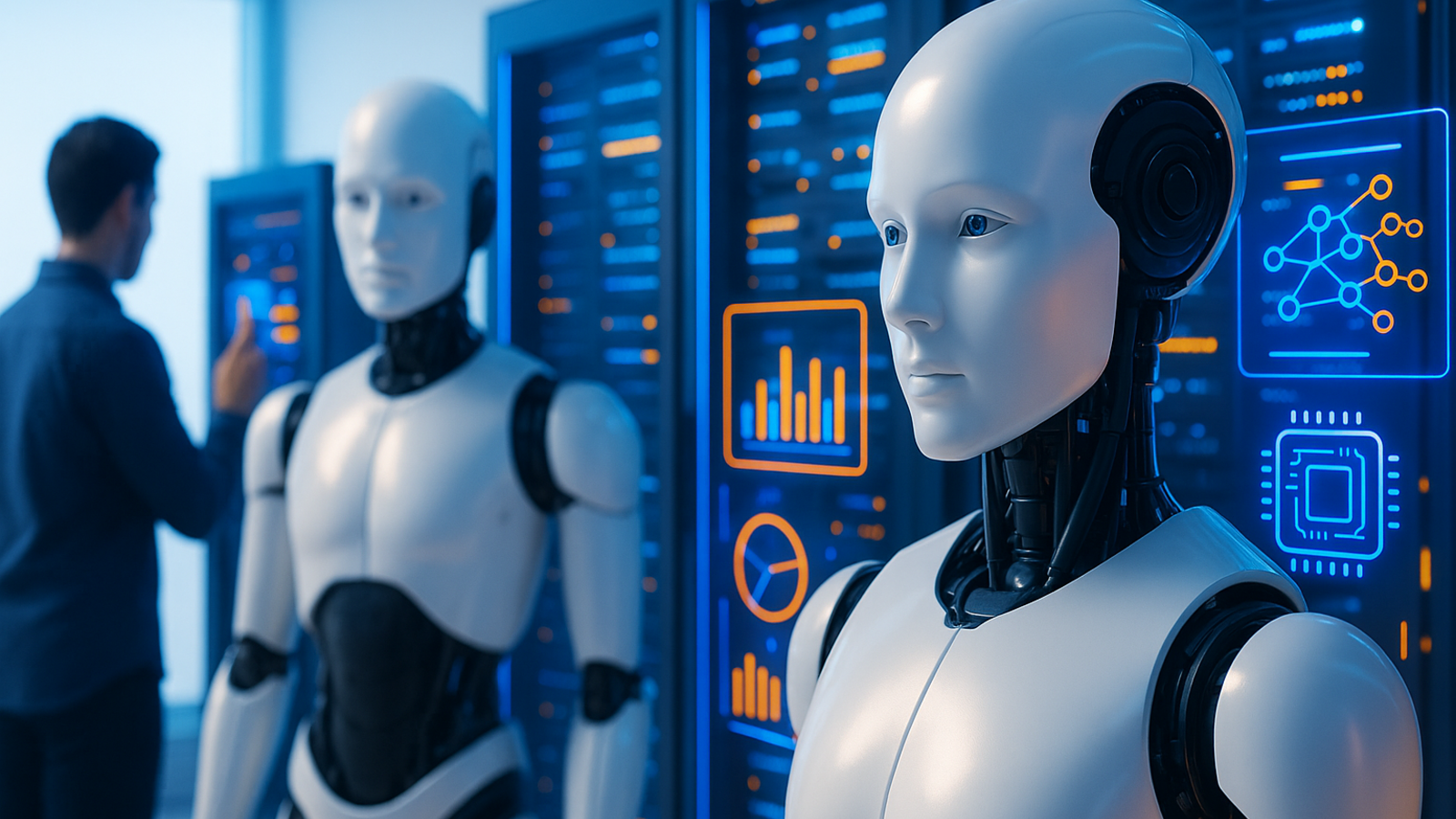
Google DeepMind’s Gemini Robotics 2 release is easy to read as another high-end lab demo: a humanoid walks, crouches, picks things up, ties bags, handles tools, and coordinates with other machines. But the deeper signal is more important for the future of robotics. AI systems are starting to move from language interfaces into embodied control loops, where the model has to perceive, plan, act, recover, and stay safe in the messy physical world.
That is the breakthrough at the center of Gemini Robotics 2. Google DeepMind is not presenting a single robot, a single gripper, or a single warehouse workflow. It is presenting a model family for physical AI: a vision-language-action model for motor control, an embodied reasoning model for planning and orchestration, and an on-device model designed to adapt across robot bodies with limited new data. If that pattern holds, robotics may start to look less like bespoke automation and more like a general AI platform with hardware plugged into it.

The Big Shift: From Scripted Machines To Embodied Agents
Traditional industrial robots are powerful but narrow. They thrive in controlled environments where tasks are repetitive, fixtures are precise, and safety zones are tightly managed. The challenge for general-purpose robotics has always been the opposite setting: homes, hospitals, offices, construction sites, retail floors, labs, farms, and warehouses where objects move, humans appear unexpectedly, tasks change, and language is imprecise.
Gemini Robotics 2 attacks that gap by splitting the stack into complementary layers. Gemini Robotics 2, the vision-language-action model, translates visual and language inputs into robot actions. Gemini Robotics ER 2 acts as the high-level embodied reasoning system, handling human communication, scene understanding, multi-step task planning, progress tracking, and coordination across robots. Gemini Robotics On-Device 2 is optimized for local inference and fast adaptation on robotic hardware.
That architecture matters because robotics is not only a motor-control problem. A useful robot must understand what a person wants, reason about whether the task is possible, sequence actions, recover when something fails, avoid unsafe behavior, and decide when to ask for help. In software-agent terms, the robot needs tools, memory, policy, monitoring, fallback behavior, and safety boundaries. Gemini Robotics 2 brings that agent pattern into the physical world.
Whole-Body Intelligence Is The New Robotics Frontier
One of the most important advances in the release is whole-body humanoid control. Previous Gemini Robotics systems focused more heavily on upper-body and tabletop manipulation. Gemini Robotics 2 expands into full humanoid motion: walking, reaching, bending, balancing, and manipulating objects across a room.
Google DeepMind describes examples where Apptronik’s Apollo 2 humanoid can interpret an instruction such as moving a watering can to a lower shelf, then walk to the object, pick it up, move to the shelf, crouch or bend as needed, and place it in the target location. That may sound ordinary because humans do it constantly. For robots, it is a difficult fusion of perception, navigation, balance, object handling, spatial reasoning, and task execution.
The significance is that whole-body intelligence changes the class of tasks available to robots. A stationary arm can assemble, weld, sort, or pack. A mobile manipulator can fetch and move objects. A humanoid with whole-body control can operate in environments already built for people: shelves, rooms, stairs, counters, doorways, carts, tools, and irregular workspaces. The closer robots get to using human spaces without rebuilding those spaces around machines, the more robotics shifts from automation infrastructure to labor infrastructure.
Dexterity Is Becoming An AI Problem
The release also highlights advances in fine manipulation across robotic hands and grippers. Gemini Robotics 2 can control the five-fingered SharpaWave hand on Apollo 2 for tasks such as tying a trash bag or sealing a ziplock bag. It can also operate a Franka Duo platform with a two-fingered Robotiq gripper for tool kitting and precision insertion tasks.
This is where the breakthrough is still uneven, and that is worth saying clearly. Google DeepMind’s own examples show strong results in several gripper and whole-body categories while acknowledging that multi-finger manipulation remains difficult. Some finger-rich tasks still have much lower success rates than simpler pick-and-place or gripper-based work.
That limitation is not a footnote. Dexterity is one of the biggest constraints on real-world robotics because so many useful tasks involve deformable objects, awkward handoffs, small parts, unexpected friction, soft packaging, tangled cords, lids, tools, and objects that are not where the robot expects them to be. If AI models can generalize dexterity across hands and grippers, robotics could move beyond rigid automation cells and into messy operational work.
Embodied Reasoning May Matter More Than Motion
The most strategically important part of the release may be Gemini Robotics ER 2. Google describes it as the high-level brain for robots, but the key detail is temporal and agentic reasoning. The system watches continuous video feeds, tracks task progress, decides when a step is complete, self-corrects when something goes wrong, and knows when to hand off to a lower-level action model or API.
Google reports that Gemini Robotics ER 2 reaches 57.4% accuracy on progress classification and 91.3% accuracy in moment-finding, with a mean absolute distance of 0.96 seconds. In practical terms, that means the model is improving at knowing whether a physical process is 20% done or 80% done, and identifying the exact moment when an event has happened. That is essential for tasks like pouring, tightening, placing, fastening, cleaning, sorting, and inspection.
This is a major AI breakthrough because physical tasks are not single prompts. They unfold over time. A robot may need to pour until a cup reaches a level, tighten until a part is seated, wait until a human clears the workspace, or retry if an object slips. The future of robotics depends on models that understand progress and state, not just objects and instructions.
Multi-Robot Collaboration Points To Fleet Intelligence
Gemini Robotics 2 also introduces multi-robot collaboration. Different machines can communicate and coordinate through a shared semantic understanding, allowing a humanoid, a bi-arm robot, or another platform to divide work across a task. This is an early but important hint of where robotics deployment may go.
In the near term, the most valuable robots may not be single general-purpose machines that do everything. They may be teams of specialized machines coordinated by AI: one robot navigates, another manipulates, another inspects, another carries, and a reasoning model assigns work dynamically. That is closer to how modern cloud systems scale: not one giant server, but many specialized services coordinated through orchestration.
For businesses, this could reshape robotics economics. A warehouse, lab, hospital, factory, or retail operation could deploy heterogeneous robots and let embodied AI coordinate them against high-level goals. The platform value would shift from the individual robot to the orchestration layer that understands the environment, assigns tasks, monitors completion, and adapts when conditions change.
On-Device Adaptation Is What Makes Robotics Deployable
Cloud-connected intelligence is powerful, but robots often need to operate with low latency, unreliable connectivity, privacy constraints, or safety requirements that cannot depend on a remote round trip. That makes Gemini Robotics On-Device 2 one of the most commercially relevant pieces of the release.
Google DeepMind says the on-device model can adapt to new bi-arm robot embodiments with a few hours of adaptation time, typically using fewer than 200 examples. The model card describes it as a VLA model based on on-device Gemma models, trained on images, text, robot sensor data, and robot action data, with outputs expressed as numerical robot actions.
If that kind of adaptation becomes reliable, it could lower one of robotics’ biggest barriers: the cost of teaching every new robot body, gripper, sensor package, and workspace from scratch. A robotics team could start with a general model, collect a focused set of local demonstrations, and adapt the system to a new embodiment or task family. That is the robotics equivalent of fine-tuning and retrieval-augmented generation becoming standard enterprise AI workflows.
Safety Becomes A Runtime Layer
As AI systems gain physical agency, safety moves from content moderation into operational control. Gemini Robotics 2 reflects that shift. Google DeepMind introduced ASIMOV-Agentic, a benchmark for agentic safety orchestration and uncertainty resolution, and its safety report focuses on capabilities such as refusing unsafe tasks, triggering protective stops, shielding low-level action models from infeasible tasks, and asking humans for clarification when instructions or scenes are ambiguous.
This is a necessary evolution. A chatbot can give a bad answer. A robot can collide, spill, crush, contaminate, drop, or enter a space it should not enter. Traditional safety mechanisms such as barriers, emergency stops, speed limits, force limits, and certified hardware still matter. But embodied AI also needs semantic safety: understanding that an instruction violates a policy, that a human is too close, that an object is unsafe to handle, or that the model is uncertain enough to pause.
That layered approach is likely to become the default robotics stack. The high-level model reasons about goals and constraints. The action model moves the robot. Low-level controllers handle balance, force, and collision avoidance. Hardware safety systems provide the hard stop. The AI breakthrough is not replacing those layers; it is making them more adaptive and context-aware.
What This Means For The Future Of Robotics
Gemini Robotics 2 does not mean general-purpose robots are suddenly ready to flood homes and workplaces. The constraints are still real: speed, reliability, dexterity, cost, battery life, certification, liability, data collection, and deployment complexity. Google’s own materials are careful about limitations, including on-device generalization and the need for discretion before production use in safety-critical environments.
But the direction is clear. Robotics is beginning to inherit the same foundation-model dynamics that transformed software. Instead of programming every task by hand, developers will increasingly compose reasoning models, action models, perception streams, tool APIs, safety policies, and embodiment-specific adapters. Robots will become less like static machines and more like physical agents that can be instructed, supervised, updated, and coordinated.
The industries affected first will likely be those where the environment is structured enough to control risk but variable enough to benefit from AI: logistics, manufacturing, laboratory automation, facilities operations, inspection, agriculture, healthcare support, and field service. Longer term, the same breakthroughs could reshape domestic robotics and elder care, though those settings carry much higher trust and safety demands.
The larger implication is that the boundary between AI infrastructure and robotics infrastructure is starting to blur. Future robotics companies will need model deployment, edge inference, fleet orchestration, observability, safety evaluation, simulation, and data pipelines as much as mechanical engineering. In other words, robotics is becoming a full-stack AI platform.
Gemini Robotics 2 is important because it shows what that platform might look like: embodied reasoning for planning, VLA models for action, local models for latency and adaptation, multi-robot collaboration for workflow scale, and safety orchestration for human environments. The robot itself may get the attention, but the real breakthrough is the AI control plane forming around it.

