
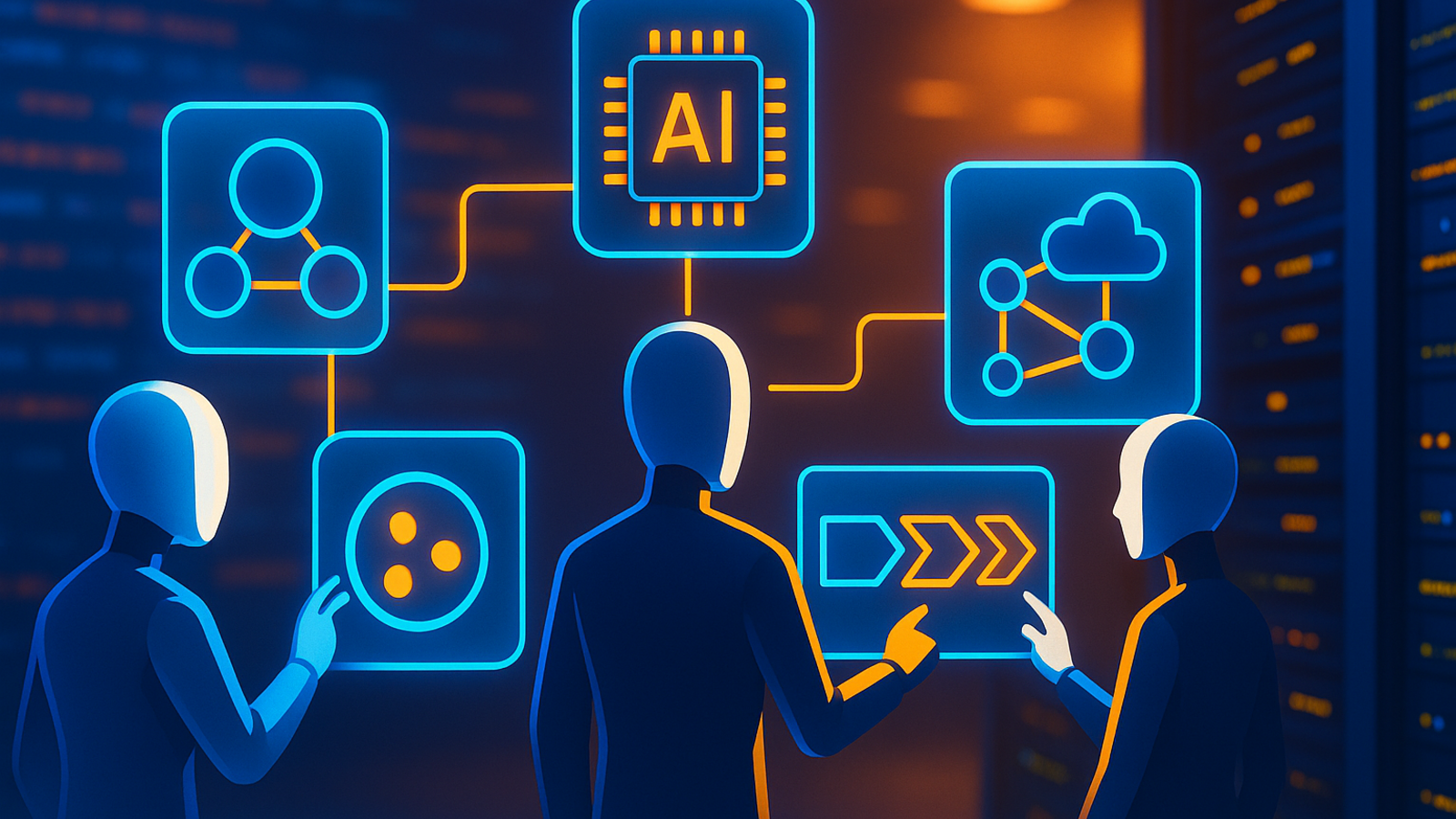
Agentic AI is no longer a speculative future for DevOps teams. It is here, and it is already forcing infrastructure vendors to rethink how code is validated, how systems are accessed, and how incidents are triaged. The week of June 2–8, 2026, brought a wave of announcements from CircleCI, HashiCorp, and Dynatrace that collectively signal a shift: DevOps tooling is being rebuilt around the assumption that AI agents, not just humans, will be primary operators.
The Agentic Validation Problem
When AI agents write code, they need feedback loops to know whether their output is correct. CircleCI published two posts this week exploring what it calls the validation shift. The core insight is that agents working on long-horizon tasks—hours or days, not minutes—require infrastructure that can validate their work at scale.

Local validation on a developer laptop works for quick tasks, but breaks down when multiple agents run in parallel, consume resources for large test suites, or need clean, reproducible environments. CircleCI proposes decoupling the agent runtime from the validation environment. Rather than colocating agents and tests on the same machine, teams should treat validation as a service that agents can invoke. This mirrors patterns like Anthropic’s Managed Agents and LangChain’s pluggable sandboxes, where the validation layer is interchangeable and independently scalable.
Using traditional CI pipelines as the feedback source is another option, but CircleCI cautions that CI is not optimized for agentic loops. Pipeline startup overhead, full-suite runs, and the inability to reuse environments between iterations make standard CI a poor fit for agents that may need dozens of rapid validation cycles. The company hints at new infrastructure—separate from traditional CI—designed specifically for agentic validation, suggesting a product direction that could reshape how DevOps teams think about feedback loops.
Rethinking Infrastructure Access for Agents
While CircleCI focuses on validating agent output, HashiCorp is tackling a parallel problem: what happens when agents need access to production infrastructure? Traditional identity and access management (IAM) models were built for human users with predictable patterns. AI agents reason and invoke tools in dynamic, unpredictable ways.
HashiCorp argues that agents should not be given long-lived static credentials, which are poorly managed, rarely rotated, and difficult to audit. Instead, the company advocates for just-in-time (JIT) access with unique identities per agent, enforced at the point of use rather than at deployment time. HashiCorp Boundary, paired with Vault, is positioned as the control plane for this new reality. When an agent initiates a session, Boundary retrieves a short-lived dynamic credential from Vault and injects it directly into the session—never exposing it to the agent itself.
This matters because agentic workloads are expanding. Agents embedded in tool runners, MCP servers, and orchestration frameworks are among the most exploitable attack vectors in the stack. HashiCorp’s message is clear: as AI footprints grow, security teams must ensure that access controls scale with them, not against them.
From Multi-Tool Triage to One-Prompt Resolution
Dynatrace and Port demonstrated what agentic observability looks like in practice. The Dynatrace MCP Server is now available inside Port via Port MCP Connectors, enabling a single natural-language prompt to trigger a complete incident triage workflow.
Here is how it works: an SRE asks Port AI what is wrong with a failing service. Port AI loads an incident-triage skill, resolves the incident entity from Port’s catalog, queries Dynatrace for logs, traces, and root cause analysis, passes the failure window to GitHub to locate suspect commits, and posts a structured triage summary to Slack. What previously required hopping between Dynatrace, GitHub, Slack, and a service catalog now runs in a single agent-driven conversation.
The integration is significant because it demonstrates agentic AI operating across tool boundaries in real time. Dynatrace provides live observability signals; Port provides service ownership, on-call rotations, and team accountability. Together, they turn fragmented incident response into a unified, queryable workflow.
Tooling Updates: CodeQL, Backstage, and OpenTofu
Beyond the agentic theme, several infrastructure projects shipped meaningful updates this week.
GitHub released CodeQL 2.25.6, adding Swift 6.3.2 support and completing full coverage for C# 14 and .NET 10. The update also improves sensitive data detection across JavaScript, TypeScript, Python, Swift, and Rust, and hardens GitHub Actions queries to better detect untrusted checkouts and unpinned tags. For security-conscious DevOps teams, this continues CodeQL’s steady expansion into newer language versions and framework-specific detection.
Backstage shipped v1.51.0 and a follow-up patch v1.51.1. The release removes deprecated APIs, hardens OIDC default patterns for MCP clients, and fixes a pagination bug in catalog entity queries. The patch release addresses a CTE materialization bottleneck that was impacting query performance at scale. For organizations using Backstage as their internal developer portal, the release is a recommended upgrade.
OpenTofu released v1.12.1, a security-focused patch fixing SSH hangs and panics and correcting a bug where revoked CA signature keys were not properly checked. The release also resolves excessive memory usage by providers introduced in v1.12.0 and fixes Azure key provider variable handling. The v1.12.0 release itself introduced dynamic prevent_destroy, allowing lifecycle policies to be expressed in terms of module variables rather than static values—a welcome flexibility for teams managing infrastructure as code.
FluxCD and GitOps Bootstrapping
FluxCD’s control-plane.io team published a new Terraform module for bootstrapping the Flux Operator. The module solves a long-standing GitOps anti-pattern: Terraform installing Flux and then fighting it for resource ownership. Instead, the module implements a create-if-missing strategy. Terraform owns only the bootstrap mechanism—namespace, temporary RBAC, and a Kubernetes Job that applies the Flux Operator and FluxInstance. Once Flux is online, it adopts the resources and Terraform stops touching them.
The module also handles prerequisites like CNI and CSI drivers, supports host-network mode when pod networking is unavailable, and ensures no secret material lands in Terraform state. It is fully compatible with OpenTofu. For teams managing Kubernetes clusters with GitOps, this is a clean, production-ready bootstrap pattern.
Tekton Pipelines Reach v1.13
Tekton Pipelines shipped v1.13.0, codenamed “Pixie-bob Project 2501.” The release introduces compressed results, timeout fixes, and a breaking change: resolvers can now only resolve Tekton objects, closing a potential security gap. The release includes signed attestations via Sigstore Rekor, reinforcing supply-chain integrity for teams running Tekton in regulated environments.
What This Means for Platform Engineers
The common thread across all of this week’s updates is that DevOps and platform engineering are being redefined by AI agents. The infrastructure we built for human developers—local test environments, static credentials, multi-tool incident runbooks—is being stress-tested by agents that move faster, work longer, and operate at larger scale.
The vendors responding to this shift are not merely adding AI features to existing products. They are rethinking core primitives: what a validation environment is, how credentials are issued, how incidents are triaged, and how GitOps tools bootstrap clusters. For platform engineers, the implication is clear. The next generation of DevOps tooling will be agent-native, not agent-augmented. Teams that start adapting their pipelines, access controls, and observability workflows now will be better positioned to operate securely and efficiently as agentic AI becomes the default mode of software delivery.
Sources
- CircleCI: Agentic validation needs different infrastructure
- CircleCI: Patterns of validation
- HashiCorp: Rethinking infrastructure access in the age of agentic AI
- Dynatrace: Port and Dynatrace one-prompt incident triage
- GitHub: CodeQL 2.25.6 changelog
- Backstage v1.51.0 release notes
- OpenTofu v1.12.1 release notes
- FluxCD: Bootstrapping Flux with Terraform
- Tekton Pipeline v1.13.0 release notes

