
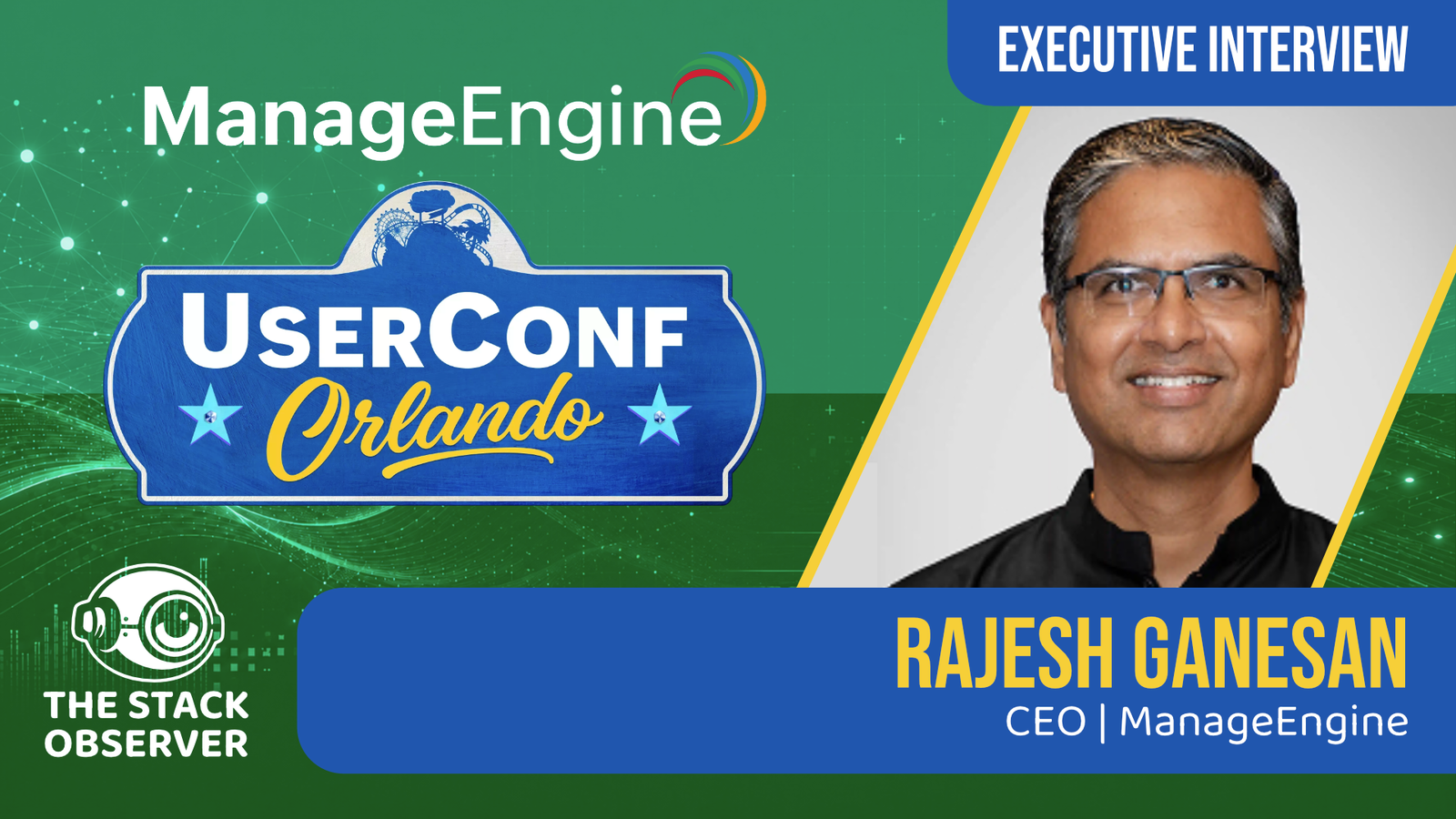
A few weeks ago The Stack Observer had the opportunity to attend ManageEngine UserConf 2026 in Orlando and sit down with Rajesh Ganesan, the CEO of ManageEngine and talk with him about the digital transformation journey from AI-ready to AI-driven and learn more about how ManageEngine is preparing their customers for AI.
Q: “What does an AI agent doing real work in an IT environment look like day to day, say on a Tuesday morning at a mid-size company?”
A: The most telling sign your agent is working how it should, is that the morning feels quieter. Picture a mid-size company on a Tuesday. Overnight, a pile of security alerts came in. By the time the security analyst sits down, the agent has sorted through them, set aside the noise, and put the few that matter at the top, with what it found alongside each one. A server slowed down around 3 a.m., and instead of starting from scratch, the team opens a ticket that already points to the likely root cause. An employee’s laptop can’t connect, and the agent has worked out why before the ticket reaches a technician.
Humans are still running things. They review what the agent surfaced, make the calls that matter, and spend their time on the work that needs judgment, like planning an upgrade or talking to a team about what it needs. The agent works within the limits the administrator set, and there’s a record of what it did, so the team can check it at the end of the day. It doesn’t look like a robot running the company. It looks like an IT team that spends less of their Tuesday morning digging and more of it deciding and executing.
Q: Cloud adoption took years and plenty of trial and error. What lessons from that wave should IT leaders apply to AI?
A: The first is that people will adopt useful tools whether or not IT has approved them. With cloud, teams signed up for services on their own, and IT often found out after the data was already out there. We’re seeing the same pattern with AI. Banning everything wasn’t the answer then, because it just pushed usage out of sight. What worked better was knowing what’s being used, giving people approved options that actually serve their needs, and setting clear rules early instead of cleaning up later.
The second is that moving to someone else’s platform doesn’t hand off your responsibility. The provider secures their side, but you’re still accountable for your data, your access, and your configuration. AI is no different. If a tool or an agent is working with your data, you still need to know what it can reach, who it’s acting as, and where the data ends up. Ask your vendors those questions and expect clear answers.
The difference this time is speed. Cloud adoption played out over years, which gave organizations room to learn as they went. AI is moving faster, so I’d encourage teams to apply these lessons from day one instead of learning them the hard way again.
Q: Can you tell me a little bit about ManageEngine, your products and how you help IT managers?
A: ManageEngine is the IT management division of Zoho Corporation, privately held and bootstrapped since day one. We started in 2004 with a simple idea: IT teams of every size should have access to enterprise-grade tools at a price that makes sense. I’ve been a part of this company for nearly 30 years, so I’ve watched that idea grow from a handful of network management tools into a full suite of 60+ products covering service management, endpoint management, identity and access, security operations, network and application monitoring, and observability.
What I hear most from IT managers is not “I need another tool.” It’s “I have too many tools, and none of them talk to each other.” I once spoke to a customer using 87 security tools from 60 different vendors. We replaced 20 of those tools in four weeks with a single ManageEngine product. That is the value of thinking holistically.
The way we help is by bringing IT together. Our products share a common foundation, so the data from your service desk, your endpoints, and your security tools gives you one picture of your environment instead of several. You can start with the one problem that’s effecting your operations the most, and add from there. You don’t have to adopt everything at once.
Q: How is your onboarding process and how do you help your users find the right products from your suite that match their business models?
A: Our onboarding process is based on the belief that customers should be helped to solve something specific, not convinced they need a product. Whether that’s resolving tickets faster, getting control of unmanaged devices, or knowing who has access to what, we want to find a way to simplify their IT. In practice, most customers start with one product that addresses their most pressing pain, and expand once they see value. Because the products are built on a shared foundation, adding a second or third product is a natural next step, not a new integration project. So honestly, we tell people to take it step by step. AI adoption and tool consolidation are both big decisions, and there is no hurry. Our job is to help customers choose the next right step for their business, not the biggest one.
But for customers who do want hands-on help, we offer guided onboarding for our identity and security products. A dedicated expert works with your team to define requirements, configure the solution in your environment, and test it against your real use cases before you sign off.
Q: You’ve talked about the digital transformation journey from AI-ready to AI-driven autonomous enterprise. Can you tell me more about what it means to be AI-ready vs. an AI-driven autonomous enterprise?
A: I think of it as three stages. Most organizations start out as AI-curious, running experiments and pilots. The next stage is AI-ready, where the tools are in place and the teams are trained. The stage we’re working toward is AI-driven, where decisions and operations become autonomous. But being AI-ready is truly mostly about getting the basics right. Your data is organized and you can trust it. Your processes are automated, so work moves along without human involvement. You’re already using AI in your day-to-day operations, and your employees and customers have a good experience with all of it. Being AI-driven is the step after, where AI doesn’t just suggest what to do but actually does the work, within rules you’ve set.
The thing holding most organizations back isn’t the AI models. The models are good, and are only getting better. The problems are more basic: systems that fail when they get busy, data that lives in five places and doesn’t agree, security and governance that vary from one tool to the next, and not enough power and computing capacity. These systems weren’t built for the scale AI demands, and that’s not anyone’s fault. But it means the best results won’t come from the smartest model. They’ll come from the most reliable foundation.
That’s why I say autonomy runs on reliability. You only hand over control to something you truly trust. If you can’t count on your systems to stay up, keep your data consistent, and follow your security and compliance rules, you can’t let AI act on its own. So the first job is building that reliable foundation, and that’s what we think ManageEngine is positioned to do.
Q: AI is developing at an unprecedented rate. What is ManageEngine’s strategy when it comes to both embracing the new possibilities brought about by AI while defending against new cyber security threats enhanced by AI?
A: I see our strategy as two sides of the same job, and on both sides we try to remain practical.
On the opportunity side, we’ve been building AI into our products for a long time, so this isn’t new to us. What has changed is how much AI can do. The big general-purpose models are great for a lot of things, but they’re often not the most efficient fit for something specific like enterprise IT. So we build AI for IT problems, like finding the root cause of an incident, sorting through security alerts, or figuring out why a device isn’t working. Zia Agents is our latest step. These are agents that can take on that kind of work across service management, monitoring, endpoint management, and security. And because we control the full stack, we can give administrators real controls: they set the limits on what an agent is allowed to do, and there’s a record of what it did.
On the threat side, AI helps attackers and defenders alike, so honestly the basics matter more than ever. Know what’s in your environment, control who has access to what, patch quickly, and keep watching. You can’t protect what you can’t see, which is why we bring IT operations and security together. AI helps our customers’ teams sort through alerts and investigate faster, but people stay accountable for the critical calls.
It’s also important to remember that AI agents create something new to protect. Every agent has an identity and access, and connects to other tools, so it can be misused like any other account. We think the same zero trust thinking should apply to agents, and you should be able to see why an agent made a decision. Then there’s a risk that gets less attention: employees pasting sensitive data into public AI tools. I tell customers to ask one simple question of any AI tool, which is where their data will be kept.
I’ll also be upfront that nobody has all the answers on governing autonomous agents yet. How do you control that? It’s a real question, and I’d encourage customers to ask it of every vendor, including us.
Check out our video interview with Rajesh to learn more

