
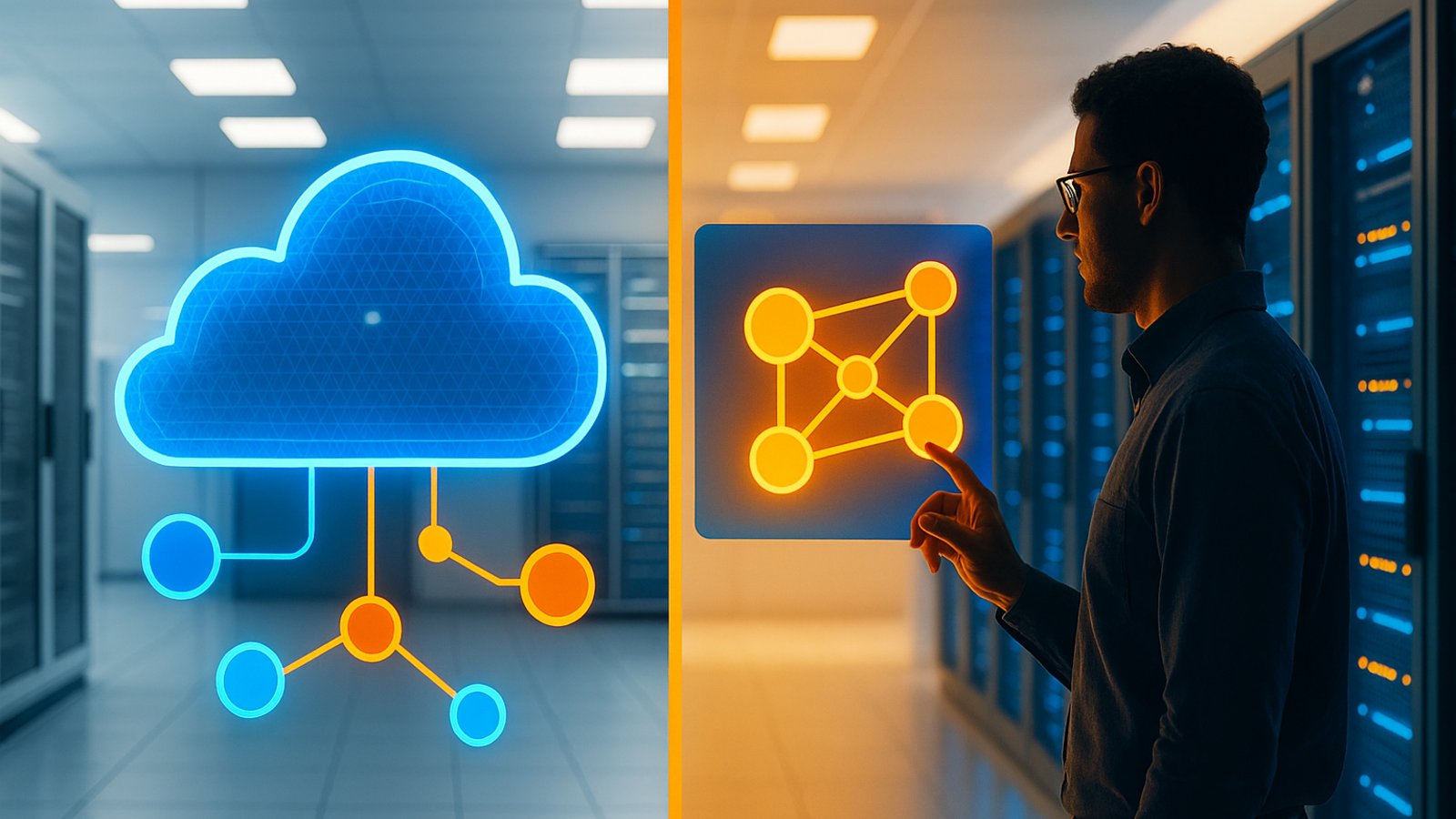
The cloud-native landscape in August 2026 is being reshaped by three converging forces: the rise of autonomous AI agents, an unprecedented surge in hyper-volumetric cyberattacks, and a new wave of observability tools built specifically for agentic workloads. Over the past two weeks, Cloudflare, the CNCF ecosystem, and production operators have all dropped significant announcements that platform teams cannot afford to ignore.
Cloudflare Agents Week: Building the Agentic Internet
Cloudflare spent the first week of August 2026 laying out what it calls the Agentic Internet—a vision where humans and autonomous software agents coexist on the same network, cooperating instead of colliding. The announcements, collectively branded as Agents Week, represent one of the most comprehensive platform bets on agent-native infrastructure to date.
At the center is @cloudflare/computer, a new runtime designed specifically for agents rather than containers. Unlike traditional containerized workloads that expect a fixed environment, an agent runtime needs to choose the right compute context for each task—sometimes a lightweight JavaScript worker, sometimes a Python process, sometimes a GPU-backed inference job. Cloudflare’s approach treats the runtime as a decision-making layer, not a static host.
The company also introduced Cloudflare Agents, a managed service that gives developers live tracing, replay, and human-in-the-loop approval for every agent run in production. This directly addresses one of the hardest problems in agent deployment: understanding what an autonomous system actually did, and being able to step in when it goes off track. Every agent session produces a trace that captures model calls, tool invocations, and sub-agent delegations—telemetry that is non-blocking by design, so agent availability never depends on a tracing backend being reachable.
Perhaps the most forward-looking announcement was Cloudflare Wallets, a programmable wallet infrastructure for the emerging agentic economy. As agents begin to perform transactions—calling APIs that charge per request, reserving compute, or even paying other agents—identity and payment primitives become critical infrastructure, not afterthoughts. Cloudflare is positioning itself as the trust layer for an internet where software, not just humans, holds accounts.
Other notable launches from the week include Workers RPC across Python and JavaScript, enabling mixed-language agent architectures; gRPC support for Workers and Containers, opening the door to real-time voice AI backends; and a Billable Usage API that gives programmatic cost visibility across Cloudflare’s self-serve products. Taken together, these pieces form a coherent platform for building, deploying, monitoring, and monetizing agentic applications.
The Agent Development Lifecycle Replaces the SDLC
Cloudflare also formalized what it calls the Agent Development Lifecycle (ADLC), explicitly positioning it as the successor to the traditional Software Development Lifecycle. Where the SDLC assumes deterministic code with predictable inputs and outputs, the ADLC acknowledges that agents are probabilistic systems that evolve through interaction. The lifecycle includes stages for prototyping, staging, production monitoring with human oversight, and continuous refinement based on real-world feedback loops.
This reframing matters because it changes what “production-ready” means for agentic software. A traditional application passes tests and deploys. An agent passes tests, deploys, and then needs guardrails that catch drift, loops, and cost explosions in real time. Cloudflare’s platform now embeds those guardrails natively.
DDoS Attacks Surge 519%: The 1 Tbps Club Is Growing
While Cloudflare was building infrastructure for cooperative agents, its network was also absorbing an unprecedented wave of hostile traffic. The company’s DDoS Threat Report for H1 2026, published August 11, revealed a 519% quarter-over-quarter surge in hyper-volumetric network-layer attacks exceeding 1 terabit per second. In the first half of the year alone, Cloudflare mitigated 935 attacks above 1 Tbps—an average of roughly 128,000 network-layer attacks per day.
The attack landscape has shifted materially. DNS floods climbed from 25.7% to 40.0% of network-layer attacks quarter-over-quarter, while CLDAP reflection floods surged 580% to become the third-most-common vector. Geopolitics is now a direct driver of traffic patterns: coverage of Iran, Ukraine, and the World Cup made Media and Production the most-attacked industry at 14.2% of all mitigated HTTP DDoS requests. Turkey rose to the third-most-attacked country amid NATO summit tensions, and the Government sector jumped from 29th to 9th place during what Cloudflare calls Operation Epic Fury.
April 2026 was the peak month, with 6.46 trillion requests and 165 petabytes of attack volume mitigated. Activity declined afterward, likely due to Operation PowerOFF, a 21-country law enforcement action that targeted over 75,000 DDoS-for-hire users, took down 53 domains, and resulted in four arrests. The takeaway is clear: DDoS is not just getting bigger—it is getting more politically and economically targeted.
Observability for AI Agents: Lessons from Production
Running AI agents in production is not the same as running traditional microservices. A container crashes with a stack trace; an agent loops, hallucinates, burns tokens, and produces subtly wrong output that looks plausible. On August 4, 2026, StackGen Principal Engineer Sabith K Soopy published a practical guide based on months of running agent systems in production, outlining what actually works for observability in this new paradigm.
The guide argues for three pillars that go beyond standard APM:
- Traces as session timelines: Every agent session should produce a structured trace capturing each model call, tool invocation, and sub-agent delegation with timing and cost attached. The key insight is that trace delivery must be non-blocking—agents should never wait on a synchronous HTTP POST to a tracing backend.
- Cost as a canary metric: Token costs are the unit economics of agents. A tight loop in a parallel agent can burn budget in seconds. Hard iteration caps, per-tool budgets, and loop detection act as circuit breakers. Alerting on session cost versus rolling average catches slower-burning anomalies like hallucination spirals.
- Audit as an immutable record: Every tool call, governance decision, and memory operation should log to an append-only, structured, timestamped record. Tool outputs containing sensitive data must be sanitized before logging.
Perhaps the most practical recommendation is the diagnostic command—a single command, modeled after brew doctor, that checks model connectivity, vector store reachability, pending approvals, memory counts, trace backend status, and integration health in one shot. One pass/fail view beats digging through five dashboards.
OpenCost Brings Inference Cost Tracking to Kubernetes
Platform teams running LLMs on Kubernetes have historically operated without a clear view of what each token actually costs. OpenCost 1.121.0, released August 5, 2026, introduces first-of-its-kind Kubernetes inference cost tracking by integrating with llm-d, a CNCF sandbox project for distributed LLM inference.
The integration exposes two cost perspectives via Prometheus metrics: allocation-based cost (the full cost of keeping a model available, including idle GPU reservation) and usage-based cost (only the costs consumed during active inference, accounting for KV cache hits). The gap between the two is effectively a GPU utilization metric. If your usage-based cost is $1.00 per million tokens and your allocation-based cost is $4.00, your utilization is 25%—and your real self-hosting cost is $4.00, not $1.00. This is the difference between thinking you are cheaper than a SaaS API and knowing you are not.
Service Mesh Observability: When Zero Plus Zero Equals Two
On August 11, 2026, Coralogix and VictoriaMetrics published a debugging guide for a subtle but costly problem in Istio service mesh observability. Teams running Prometheus against mesh telemetry often find that two zero-error metrics from different sidecars combine into a nonzero total because of aggregation overlap and double-counting. The post walks through techniques to identify and deduplicate these overlaps—a timely reminder that more telemetry is not always better telemetry, and that correlation and cleanup matter as much as collection.
Lima v2.2: Windows, TPM 2.0, and Cross-Platform VMs
Lima, the lightweight VM manager that has become a staple of container developers on macOS and Linux, released version 2.2 on July 28, 2026, adding Windows guest support alongside existing Linux, macOS, and FreeBSD guests. A single limactl workflow can now boot any of the four operating systems, making Lima a genuinely cross-platform local development environment.
The release also introduces TPM 2.0 emulation, enabling local testing of Windows 11 and secure-boot workflows without dedicated hardware. For developers building cross-platform container images or testing Kubernetes clusters on Windows nodes, this removes a significant friction point.
Kubernetes DRA and the Future of GPU Sharing
An August 7 post by Mesut Oezdil examined whether Kubernetes Dynamic Resource Allocation (DRA) can replace HAMi, the existing GPU sharing device plugin. The legacy device plugin interface was built to count devices, not share them: nvidia.com/gpu: 1 means one whole GPU, period. DRA, maturing in Kubernetes 1.32+, offers a more flexible resource model that can express partial GPU allocation natively. Whether it fully supersedes HAMi is still open, but the direction is clear: Kubernetes is evolving its resource model to match the reality of AI workloads.
What This Means for Platform Teams
The theme across all these developments is the same: the cloud-native stack is being rebuilt for an agentic, AI-driven world. Cloudflare is betting the platform on autonomous software. DDoS attackers are targeting the infrastructure that hosts it. Observability vendors are inventing new signal types because traditional metrics cannot explain agent behavior. And Kubernetes cost tooling is finally catching up to the economics of GPU inference.
For platform teams, the message is that the gaps are no longer in the core infrastructure—they are in the operational patterns around it. Agent guardrails, inference cost attribution, mesh telemetry deduplication, and cross-platform development environments are all solvable problems, but they require thinking beyond the last generation of tooling.
Sources
- Everything we launched during Agents Week — Cloudflare Blog
- Cloudflare DDoS Threat Report H1 2026 — Cloudflare Blog
- You can’t debug what you can’t see — Observability for AI Agents — CNCF Blog
- OpenCost 1.121.0: First-of-a-kind Kubernetes inference cost tracking — CNCF Blog
- A practical guide to solving when zero+zero=two in mesh observability — CNCF Blog
- Lima v2.2: Windows guests and TPM 2.0 emulation — CNCF Blog
- Does Kubernetes DRA Replace HAMi? — CNCF Blog
- Cortex completes OSTIF security audit — CNCF Blog

