
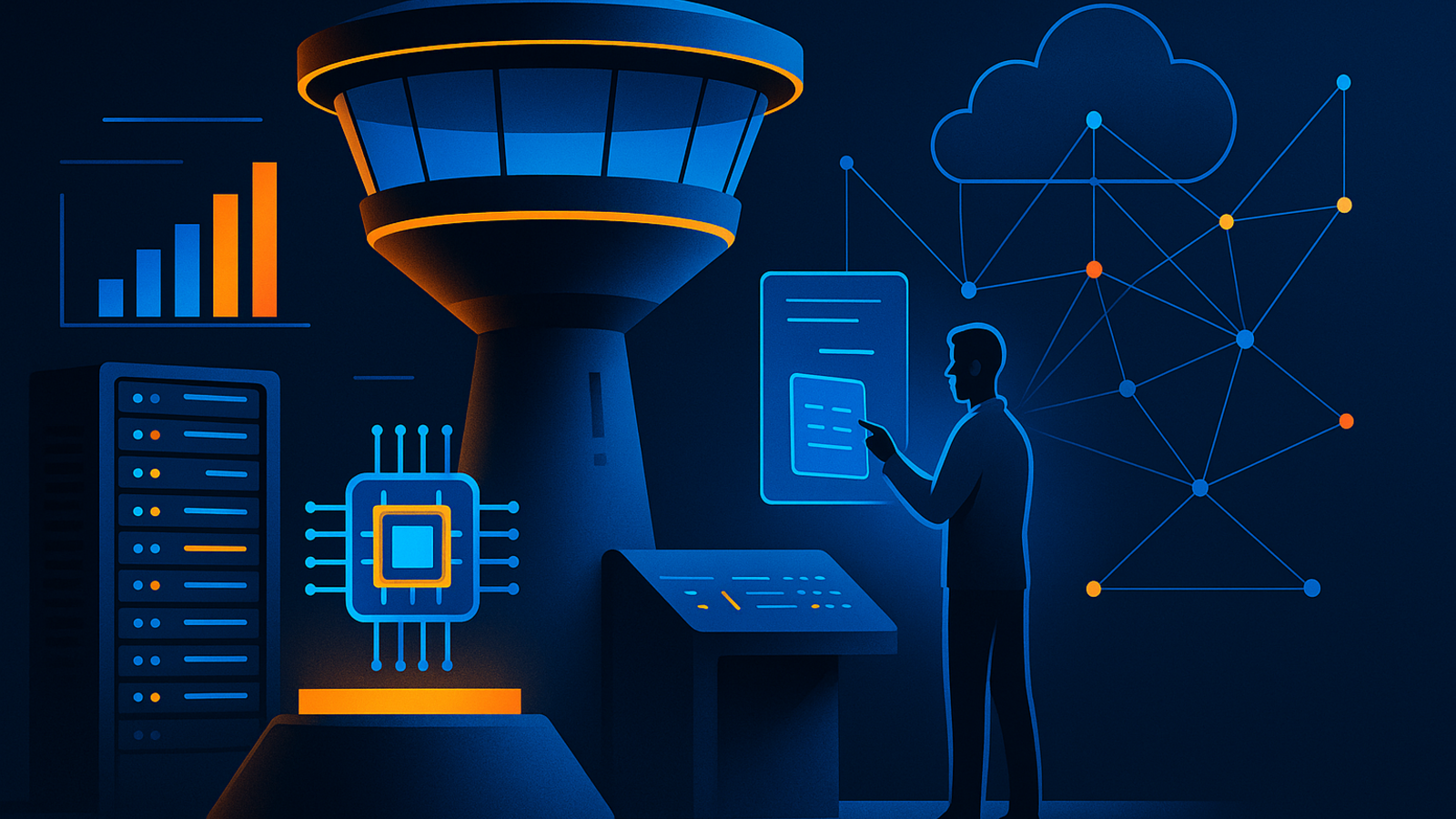
The promise of AI-driven infrastructure has arrived faster than most organizations expected. Agents now author Terraform, open pull requests, trigger CI/CD pipelines, and manage Kubernetes deployments — all without a human touching each step. But speed without governance is just a faster way to break production. That is exactly why platform engineering teams are treating “control planes” as the defining architecture pattern of 2026.
From Autocomplete to Autonomous Infrastructure
What changed? AI coding agents have moved well beyond autocomplete. They now run a continuous loop: plan, execute, observe, reflect, repeat. That loop operates at machine speed, 24/7, without the natural pauses where a human would typically review and approve. The bottleneck has shifted from writing infrastructure code to verifying it — and the tools built for human-paced workflows are being stretched to their limits.
HashiCorp made this explicit in a recent announcement: HCP Terraform is the control plane for AI-driven infrastructure. The core idea is that agents should propose changes, not decide on them. Every agent-authored modification must flow through the same enterprise controls that human operators already rely on — provenance, policy, identity, isolation, and audit trails.
Five Layers of Defense Between Agent Output and Production
Control planes work because they enforce layered defense. HashiCorp outlined five critical layers that keep autonomous infrastructure safe:
Provenance anchors the agent in authoritative context — approved Private Registry modules, organizational standards, and Terraform MCP integrations — so the agent reasons from your sources instead of generic training priors. Without provenance, hallucinations in infrastructure code become catastrophic: an agent might invent a plausible but wrong security group rule or misconfigure a storage bucket because it was “confident” about an API it only partially understands.
Policy gates every run. HCP Terraform’s policy-as-code and run tasks evaluate agent output before anything mutates in the cloud. Required approvals remain mandatory. The agent can propose; it cannot apply without passing the same checks a human-authored change would face.
Identity matters because an agent needs credentials to do anything. Dedicated, project-scoped identities that issue dynamic provider credentials per run — and revoke them immediately afterward — ensure that even a compromised agent cannot retain persistent access. Scoped RBAC within projects and workspaces further limits blast radius.
Isolation through projects and workspaces binds state, variables, and permissions to a boundary. A mistake in one workspace cannot cross into another. This was already best practice for human teams; it becomes non-negotiable when an agent is running unattended loops at 3 a.m.
Audit history preserves plan output, policy decisions, approvals, and apply records as durable evidence. When something goes wrong — and it will — the run history is what lets platform engineers reconstruct exactly what the agent did, when, and why.
The GitOps Ecosystem Is Maturing Alongside
While HashiCorp is positioning HCP Terraform as the control plane for declarative infrastructure, the broader GitOps ecosystem is solving complementary problems. The Argo project released Argo Rollouts 1.10 with more reliable reconciliation, safer Job-based analysis, and expanded plugin support for traffic routing. Meanwhile, the Argo CD 2026 user survey revealed that 80% of organizations deploying AI/ML workloads now use Argo CD for those deployments — and 42% of respondents manage 500+ Applications in a single instance. Performance at scale is now the community’s top pain point, which is driving architectural investment.
Over in the Flux camp, the project introduced selective drift correction with ignore rules. This is a pragmatic answer to a real problem: when multiple controllers legitimately mutate the same Kubernetes resource, Flux’s drift correction used to fight them. Now teams can tell Flux to ignore specific JSON Pointer paths — like spec/replicas when a HorizontalPodAutoscaler owns scaling — while still reconciling everything else. It is exactly the kind of field-level precision that control-plane thinking demands.
Platform Engineering Is the Operating Model
Backstage, the open-source developer portal that underpins many internal platforms, shipped v1.53.0 with a significant shift: database-backed user settings storage, stricter OAuth matching, and the migration of core catalog components to Backstage UI (BUI). The pattern is consistent across the ecosystem — platform tooling is consolidating, hardening, and adding the enterprise controls needed for broader organizational adoption.
The industry conversation has also shifted. The Register published a piece titled “Platform Engineering 2.0: your platform was built for a different era. AI just exposed it.” The argument is straightforward: platforms built before the agentic era assumed a human in the loop for every meaningful decision. That assumption no longer holds. Platform engineering now means building the guardrails, control planes, and verification gates that agent output must clear — not just the paved roads that humans walk.
What This Means for DevOps Teams
Platform engineers should expect three practical shifts in the next 12 months:
First, agent-authored infrastructure changes will become normal, not experimental. The role of the platform engineer shifts from writing configuration to writing the workflows, specifications, and verification gates that agent output must satisfy. Less YAML by hand; more policy-as-code and module standards.
Second, “drift detection” and “reconciliation” will need to become field-aware and multi-controller-aware. The Flux ignore rules model — granular, path-specific, and identity-aware — is likely to be copied by other GitOps tools because it solves a real operational problem.
Third, performance at scale will dominate GitOps roadmaps. The Argo CD survey numbers are striking: 42% of users at 500+ Applications, 25% running more than 10 instances. The next generation of GitOps controllers will need to handle that scale without requiring sharding or manual optimization.
Bottom Line
AI agents running infrastructure autonomously is not a future scenario — it is happening now in early-adopter organizations. The question is whether those agents operate inside a hardened control plane or outside it. The platform engineering community has made its choice clear: governance first, speed second. Because a fast agent with broad cloud access and no guardrails is not a productivity tool. It is an incident waiting to happen.

