
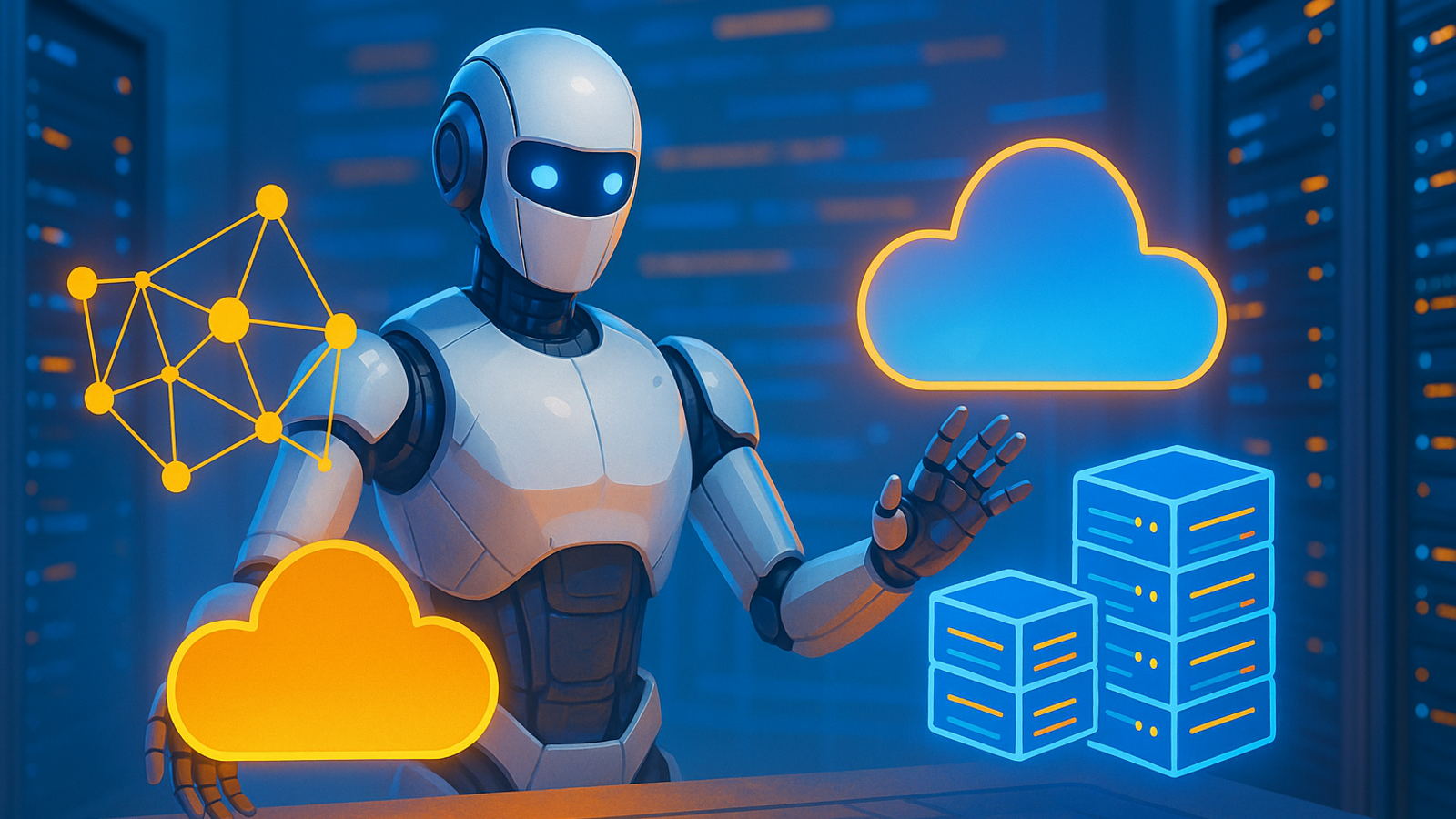
The line between “AI-assisted” and “AI-native” infrastructure operations is collapsing faster than most teams expected. In the past month alone, HashiCorp, CircleCI, Dynatrace, GitHub, and Argo CD have all shipped or announced capabilities that use the Model Context Protocol (MCP) — or MCP-like interfaces — to let AI agents directly interact with production-grade DevOps tools. What used to require CLI expertise, multiple dashboards, and tribal knowledge is increasingly accessible through a single conversational interface.
This shift is not theoretical. Organizations are already deploying AI agents that provision infrastructure through Terraform MCP servers, triage incidents via Dynatrace’s observability MCP, and manage CI/CD pipelines with CircleCI’s natural-language interface. The common thread: these tools are giving AI agents context — real infrastructure data, policy definitions, and operational state — rather than letting them guess based on training data.
Why MCP Is the Right Protocol at the Right Time
Large language models are powerful but inherently non-deterministic. When an AI agent tries to provision a Kubernetes cluster or diagnose a production incident without access to the actual state of your infrastructure, it is operating on probabilistic assumptions. It does not know your module registry, your tagging policies, your compliance requirements, or your network topology. That gap between “general knowledge” and “organizational truth” is where hallucinations, misconfigurations, and security risks creep in.
The Model Context Protocol, originally developed by Anthropic but rapidly becoming an open standard, solves this by creating a structured bridge between an AI agent and a specific tool or data source. Instead of the agent reasoning in a vacuum, it queries an MCP server that has direct access to Terraform state, Dynatrace metrics, Argo CD application manifests, or GitHub repository metadata. The agent gets authoritative context, makes decisions grounded in reality, and then executes actions through the same MCP interface.
HashiCorp put it plainly in their recent blog post: “Rather than allowing AI agents to operate based solely on training data and probabilistic reasoning, MCP provides authoritative context directly from Terraform workflows, modules, policies, workspaces, and infrastructure configurations.”
Pattern 1: Terraform as an AI-Native Platform Interface
HashiCorp’s Terraform MCP server, announced in late June 2026, is arguably the most mature example of this pattern. It exposes Terraform’s private module registry, workspace configurations, Sentinel/OPA policies, and infrastructure state to AI agents in a structured way. The result is four concrete patterns that platform engineering teams are already exploring:
No-Code Infrastructure Workflows
Organizations that have invested in no-code Terraform modules can now expose them through AI-driven interfaces. A newly hired DevOps engineer can ask an MCP-enabled assistant to “test the no-code module terraform-aws-eks-standard in the dev environment and validate whether it follows organizational standards.” The agent retrieves the module contract, runs validation, executes speculative plans, checks tflint rules, and explains results in natural language — all without the engineer touching raw Terraform code on day one.
Self-Service via Private Module Registry
For more advanced users, the MCP server can discover and compose approved modules from the private registry. An engineer requesting a development environment might say, “Build a compliant dev environment using approved modules terraform-aws-eks-standard, rds, and redis-ec2.” The agent generates a compliant Terraform configuration, validates it, and can even analyze the impact of future module upgrades — all while maintaining centralized governance.
Policy as Code Enforcement
Sentinel and OPA policies are notoriously difficult to write correctly. The Terraform MCP server helps AI agents understand organizational governance requirements and assist both policy authors and infrastructure consumers. Policy authors get help translating high-level requirements — “Restrict deployments to approved regions, enforce mandatory tagging, ensure encryption is enabled” — into working Sentinel or OPA rules. Consumers get real-time feedback before their changes ever reach a Terraform plan.
Day-2 Operations and Cost Optimization
Perhaps most interesting is the operational side. The MCP server can analyze historical Terraform runs to identify optimization opportunities, unused resources, and cost anomalies. An agent with access to workspace metadata and state can answer questions like “Which dev environments have been idle for more than 30 days?” without requiring a human to manually query across multiple cloud consoles.
Pattern 2: Observability Becomes Conversational
Dynatrace and Port have integrated the Dynatrace MCP server to enable what they call “one-prompt incident triage.” Rather than switching between Jira, Dynatrace, and Slack during an incident, a platform engineer can ask a single question in Jira or their internal developer portal: “What is causing the elevated error rate in the payments service?”
The MCP server queries real-time metrics, traces, and logs, then returns a structured analysis — complete with root cause hypotheses, affected dependencies, and recommended remediation steps. This is not a generic LLM summarizing what it thinks might be wrong. It is an AI agent with direct access to observability data, grounding its analysis in actual production telemetry.
Dynatrace is also expanding this to LLM evaluation frameworks (dt-evals) and autonomous incident resolution, where AI agents not only diagnose problems but orchestrate multicloud remediation workflows. The observability vendor is positioning itself as the nervous system for agentic AI operations — and the MCP server is the synapse.
Pattern 3: CI/CD Pipelines You Can Talk To
CircleCI’s MCP server takes a different angle: natural language CI. Instead of writing YAML configurations or navigating the CircleCI web UI, developers can describe what they want in plain English. “Run the payment-service tests on every pull request, but only if the Go files changed.” The MCP server translates this intent into a working pipeline configuration.
More importantly, CircleCI is positioning its MCP server for what they call “autonomous validation” — AI agents that not only trigger pipelines but interpret results, retry failed jobs intelligently, and suggest fixes. The Chunk agent, announced alongside the MCP server, promises “inner loop validation that keeps up with your agents” — meaning AI-generated code can be validated at AI speed, not human speed.
The implications for developer experience are significant. Platform teams spend enormous effort writing documentation and maintaining self-service portals. An MCP-enabled CI/CD interface could reduce much of that friction by letting developers interact with pipelines conversationally, while the platform team maintains governance through policy definitions that the MCP server enforces.
Pattern 4: GitHub’s Copilot Ecosystem Expands Into Operations
GitHub is not sitting this out. In June 2026 alone, GitHub shipped three notable Copilot expansions that blur the line between coding and operations:
- GitHub Desktop 3.6 now runs Copilot on the Copilot SDK, with model pickers, bring-your-own-key (BYOK) support, AI-powered commit authoring that respects repository standards, and AI-assisted merge conflict resolution. The addition of Git worktrees means coding agents can spin up isolated parallel sessions — a pattern increasingly common in AI-driven development.
- MAI-Code-1-Flash, Microsoft’s in-house coding model, is now generally available for Copilot Business and Enterprise, optimized for high-volume agentic coding workflows.
- Copilot adoption tracking now includes total merges by adoption phase, giving platform teams concrete data on how AI adoption correlates with delivery throughput.
The Copilot SDK is the key architectural move here. By providing a shared foundation for AI features across GitHub’s surfaces — Desktop, Codespaces, the web UI, and soon CLI — GitHub is creating the same kind of standardized interface that MCP provides for third-party tools. The difference is that Copilot is optimized for code-centric workflows, while MCP is tool-agnostic.
The Argo CD Angle: GitOps Infrastructure Gets an AI Upgrade
While not explicitly using MCP yet, Argo CD v3.5 (currently in release candidate) is laying groundwork that aligns perfectly with agentic infrastructure patterns. The new ApplicationSet UI with built-in change previews lets AI agents — or human operators using AI assistance — visualize the impact of GitOps changes before they are deployed. Source Hydrator advances to beta with support for separate dry and hydrated manifest repositories, enabling advanced multi-repository GitOps patterns that AI agents can reason about more cleanly.
More critically, impersonation moves to beta. This means AI agents can perform operations with specific user contexts — essential for audit trails and multi-tenant security. Source integrity validation ensures that only signed, trusted manifests are hydrated and deployed, providing defense-in-depth against supply chain attacks. These are precisely the guardrails that organizations need before they grant AI agents broader access to production GitOps workflows.
The mTLS support for repo-server communications and Helm 4 compatibility further strengthen Argo CD’s position as the GitOps backbone for AI-augmented platform engineering.
What This Means for Platform Engineering Teams
The convergence of MCP servers, AI agents, and infrastructure tooling is forcing a reassessment of what “platform engineering” means. Traditionally, platform teams built abstractions — self-service portals, golden path templates, internal developer platforms — that required human users to navigate structured interfaces. The new pattern is conversational: developers describe intent, AI agents translate intent into infrastructure, and MCP servers ensure those translations are grounded in organizational standards.
For platform engineers, this creates both opportunity and risk. The opportunity is massive efficiency gains: onboarding new engineers through guided AI workflows, automating routine provisioning and policy enforcement, and reducing the operational burden of maintaining complex self-service systems. The risk is that AI agents with poorly scoped MCP access can bypass governance controls or make decisions based on incomplete context.
The organizations that succeed will be those that treat MCP server configuration as a first-class infrastructure concern — with proper authentication, scoped permissions, audit logging, and fallback mechanisms for when AI agents encounter edge cases they cannot resolve. This is not “set and forget” automation. It is a new operational model that requires the same rigor as any other production system.
Looking Ahead: The Standards Question
One open question is whether MCP itself will remain the standard protocol. Anthropic’s open approach has gained traction rapidly, but major vendors like GitHub are building their own SDKs and interfaces. The risk is fragmentation: if every tool exposes a different AI integration pattern, agents become tool-specific rather than composable.
The most likely outcome is a layered model: MCP (or a successor standard) handles low-level context exchange between agents and tools, while higher-level frameworks like GitHub’s Copilot SDK, LangChain, and Backstage’s plugin architecture compose those primitives into developer-friendly workflows. Terraform’s state, Dynatrace’s metrics, and Argo CD’s manifests all become data sources that any agent can query through a common protocol — but the orchestration layer above that remains competitive.
The Bottom Line
The past month has made one thing clear: AI agents are no longer just coding assistants. They are becoming operational interfaces for infrastructure management, observability, CI/CD, and platform governance. The Model Context Protocol is the connective tissue making this transition possible, giving agents the organizational context they need to make reliable decisions.
For DevOps and platform engineering teams, the question is no longer whether to integrate AI, but how to do so safely. Start with scoped MCP servers for read-only operations, enforce policy as code for any AI-initiated changes, and build human-in-the-loop workflows for high-risk actions. The tooling is here. The patterns are emerging. The next phase of platform engineering is conversational — and it is already underway.
Sources
- HashiCorp: Terraform MCP Server — Four Real-World AI Infrastructure Patterns
- Argo Project: Argo CD v3.5 Release Candidate
- GitHub: GitHub Desktop 3.6 — Worktrees and Deeper Copilot Integration
- GitHub: MAI-Code-1-Flash for Copilot Business and Enterprise
- GitHub: Track Total Merges by Adoption Phase in Enterprise Reports
- Terraform v1.16.0-alpha20260626 Release Notes
- Backstage v1.52.0 Release Notes
- CircleCI Blog (MCP Server and Chunk Agent announcements)
- Dynatrace Blog (MCP Server and AI Observability coverage)
