
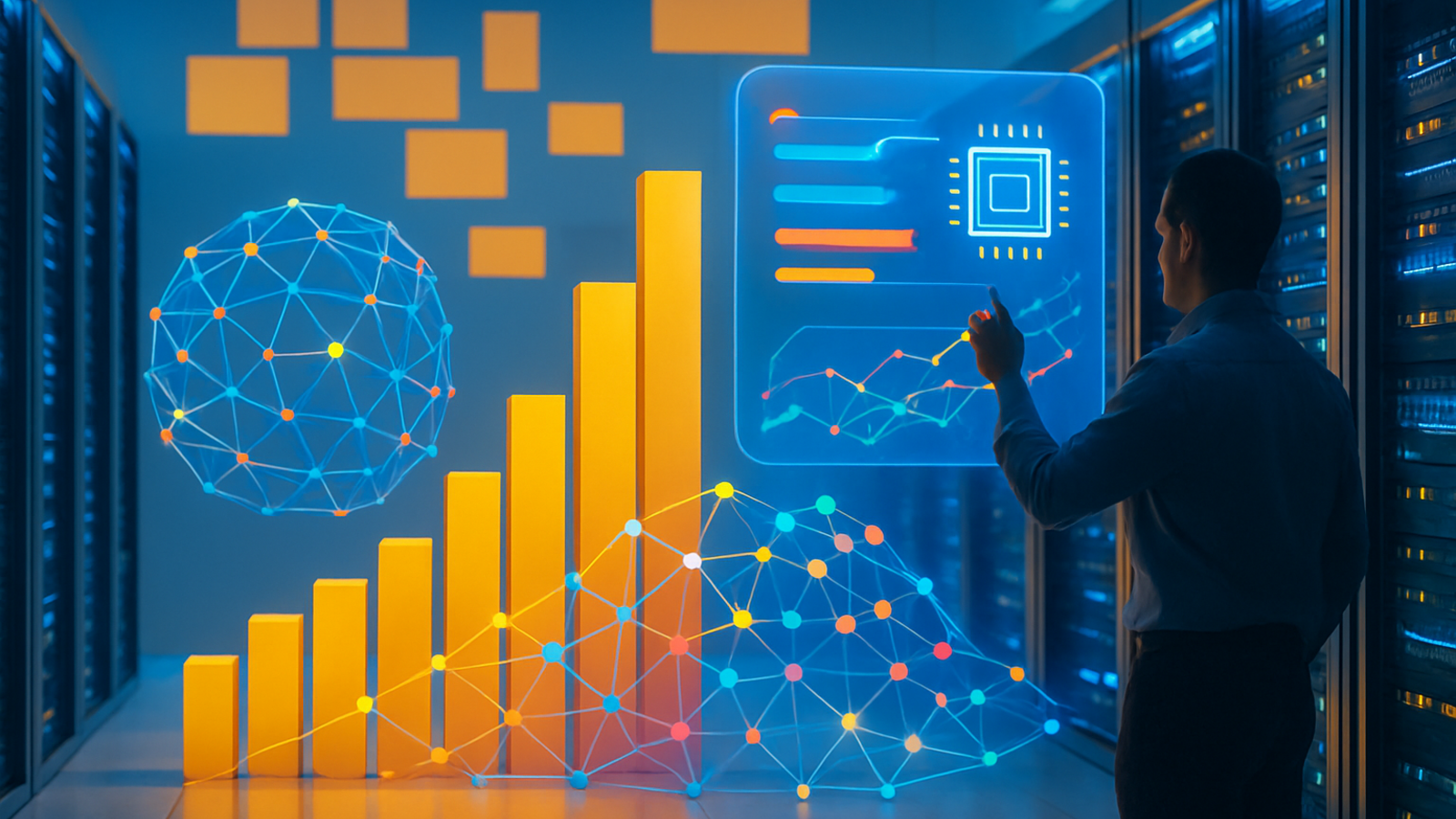
AI infrastructure is undergoing its most consequential transformation since the GPU boom of 2023. What began as a race to train larger models has matured into a layered ecosystem where inference optimization, agent-native serving, enterprise lifecycle management, and local deployment are the new battlegrounds. This week, announcements from NVIDIA, Hugging Face, OpenAI, Anthropic, and the open-source community reveal a field converging on a single insight: the infrastructure layer must be rebuilt for agents, not just chatbots.
Enterprise Manageability Becomes a First-Class Requirement
On June 9, NVIDIA published a detailed overview of DGX Spark Enterprise Manageability, signaling that AI workstations are no longer experimental toys but production infrastructure requiring the same operational discipline as any enterprise server fleet. The framework provides a six-phase operational lifecycle: procurement, provisioning, monitoring, maintenance, incident response, and end-of-life retirement.
What makes this significant is the explicit design for air-gapped and disconnected deployments. Many enterprises cannot connect AI workstations to the public internet, yet they still need automated provisioning, health monitoring, and patch management. DGX Spark addresses this with cloud-init-based custom installation, agentless SSH execution, and standardized JSON output that integrates directly into existing CMDB and SIEM pipelines. A single diagnostic tool, spark_diagctl.py, returns bounded health summaries in L1 mode and full evidence bundles in L2 mode—no resident management agent required.
This is not incremental. It is NVIDIA acknowledging that AI infrastructure has crossed the chasm from research labs to IT departments, and those departments have compliance, security, and change-management requirements that cannot be waived.
Agentic Inference Demands a New Serving Stack
While enterprise IT gets its house in order, the serving layer is being rewritten for a workload profile that did not exist eighteen months ago: agentic inference. Coding agents like Stripe’s (1,300+ PRs per week), Ramp’s (30% of merged PRs), and Spotify’s (650+ monthly) generate a fundamentally different traffic pattern than human chat users. NVIDIA’s Dynamo team quantified it: after the first API call writes conversation context to KV cache, subsequent calls hit 85–97% cache reuse. For agent teams, aggregate cache hit rates reach 97.2% across multiple workers. The system reads from cache nearly twelve times for every token it writes.
This write-once-read-many (WORM) pattern is the central optimization target for agentic inference. NVIDIA Dynamo is attacking it at three layers:
- Frontend: Multi-protocol support for v1/responses and v1/messages APIs, which use typed content blocks instead of flat strings. This lets the orchestrator see thinking, tool calls, and text as distinct objects and apply different cache policies per block type.
- Router: New “agent hints” allow harnesses (Claude Code, Codex, OpenClaw) to attach structured signals—priority, estimated output length, speculative prefill requests—so the orchestrator can make agent-aware scheduling decisions.
- KV Cache Management: Prefix matching, cache placement, and eviction policies tuned for long-running sessions with tool-call gaps measured in minutes or even days.
The result is an inference stack that treats agent harnesses as first-class citizens rather than afterthoughts bolted onto chat completion endpoints.
The Open Source Response: OpenEnv Standardizes Agent Training
On June 8, Hugging Face announced that OpenEnv—a protocol for creating agentic execution environments—would be governed by a multi-stakeholder committee including Meta/PyTorch, NVIDIA, Modal, Prime Intellect, and Hugging Face itself. The project is supported by vLLM, Lightning AI, Stanford’s Scaling Intelligence Lab, Scale AI, and over a dozen other organizations.
OpenEnv’s repositioning is telling: it is now explicitly a protocol layer, not a reward framework. It standardizes how environments are published, deployed, and consumed via Gymnasium-style APIs over HTTP and WebSocket, with MCP as a first-class citizen. The insight is that open-source agents cannot achieve the hand-in-glove optimization that frontier labs enjoy unless the community agrees on a common socket between harnesses, environments, and trainers. OpenEnv aims to be that socket.
This matters because the open-source inference stack—vLLM, SGLang, TensorRT-LLM, llama.cpp, Ollama—has been advancing rapidly, but training infrastructure for open agents has lagged. OpenEnv closes that gap.
Local Inference Goes Mainstream with Quantized Agents
Another sign of infrastructure maturation: Holo3.1, H Company’s computer-use agent family, shipped its first quantized checkpoints on June 2. The 35B-A3B model is available in FP8, Q4 GGUF, and NVFP4 (W4A16 via NVIDIA Model Optimizer). On DGX Spark, NVFP4 delivers 1.74× the throughput of BF16 and 1.41× that of FP8, with negligible accuracy loss.
More importantly, Holo3.1 is designed for fully local deployment. The agent harness runs on Windows or Mac, while the model executes on the same machine or a local DGX Spark. Nothing leaves the user’s network. Combined with cross-harness function-calling support and mobile automation improvements (79.3% on AndroidWorld, up from 67%), this represents a credible path to private, on-device agents.
Ollama has also been expanding its model catalog, recently partnering with OpenAI and ROOST to bring gpt-oss-safeguard reasoning models (20B and 120B) to local users for safety classification tasks. The message is clear: the boundary between cloud and local inference is blurring, and infrastructure must support both seamlessly.
Model Releases Pressure the Infrastructure Layer
The infrastructure story cannot be separated from the models driving demand. Anthropic shipped Claude Fable 5 and Claude Mythos 5 on June 9, targeting the hardest knowledge work and coding problems. OpenAI filed a confidential S-1 with the SEC on June 8 and expanded Codex to “every role, tool, and workflow” on June 2. NVIDIA’s Nemotron 3 Ultra arrived in early June, explicitly optimized for long-running agents with efficient reasoning across many turns.
Each of these models increases inference load. Each introduces new capabilities—longer context, tool use, reasoning—that stress existing serving infrastructure in novel ways. The infrastructure providers are responding not by building bigger datacenters alone, but by rearchitecting the software stack to handle agent-specific patterns: disaggregated prefill/decode, speculative decoding, prefix caching, and quantization-aware serving.
What This Means for Teams Building Today
For practitioners, the takeaway is that AI infrastructure is splintering into specialized layers, and the generic “throw GPUs at it” approach is no longer sufficient:
- If you run enterprise AI: Operational maturity is now table stakes. Air-gapped provisioning, fleet diagnostics, and change-managed updates are non-negotiable.
- If you serve agents: Your inference stack must understand harness hints, cache prefixes across long sessions, and route requests based on agent state—not just queue length.
- If you train open models: OpenEnv is becoming the standard substrate. Aligning your training pipelines with it future-proofs your work.
- If you prioritize privacy: Quantized local inference is now competitive. NVFP4 and Q4 GGUF deliver near-cloud performance without data leaving the device.
The next six months will likely see consolidation around a few dominant inference engines—vLLM for throughput, SGLang for interactivity, TensorRT-LLM for NVIDIA-native deployment, Ollama for local simplicity—each differentiated by how well they serve agentic workloads. The winners will be the ones that treat agents as native citizens, not guests.
Sources
- NVIDIA: Delivering Lifecycle Control for AI Infrastructure at Scale with DGX Spark Enterprise Manageability
- NVIDIA: Full-Stack Optimizations for Agentic Inference with Dynamo
- Hugging Face: The Open Source Community is backing OpenEnv for Agentic RL
- Hugging Face: Holo3.1: Fast & Local Computer Use Agents
- Anthropic: Claude Fable 5 and Claude Mythos 5
- OpenAI News (Codex expansion, S-1 filing)
- NVIDIA: Nemotron 3 Ultra Powers Faster, More Efficient Reasoning for Long-Running Agents
- Ollama Blog (gpt-oss-safeguard partnership)
- vLLM Blog

